Sep 19, 2026

Should You Buy in Brampton Now or Wait for Lower Rates?

Should you buy a home in Brampton now or wait for interest rates to drop?

There is no scheduled rate cut to wait for. The Bank of Canada has held its policy rate at 2.25% through seven consecutive decisions, and five-year fixed rates actually moved up in August 2026 because they track bond yields, not the overnight rate. Meanwhile Brampton prices are down roughly 8% year over year and homes are taking about 30 days to sell. You are waiting for a discount you already have, and betting against the one thing that would take it away.

By Sunny Gawri | September 19, 2026

Here's the part nobody tells you: if rates drop the way you're hoping, you will not save money. You will pay more.

That sounds backwards, so let's walk through it with real Brampton numbers.

Where the market actually sits right now. For the 28 days ending September 16, 2026, the average sold price in Brampton was $853,000 — down 8.4% from a year earlier. Detached homes averaged $978,000 (down about 7%), townhouses $723,000 (down about 7%), and condo apartments $431,000 (down about 11%). Homes sold in an average of 30 days at 97% of asking. There were 1,054 new listings against 365 sales — roughly 2.9 new listings for every home that sold.

On the financing side, the Bank of Canada held at 2.25% on September 2, 2026, its seventh straight hold, with the next decision set for October 28. As of mid-September, a five-year fixed sits near 4.39% insured and 4.79% uninsured, with variable around 3.45% insured.

Two numbers in there matter more than the rest: 8.4% down, and 2.9 listings per sale. That combination is the entire buyer opportunity, and it exists because rates are where they are.

The math most buyers get wrong

Run the two scenarios you're actually choosing between.

Scenario A — Buy the detached home today
$978,000 purchase · 20% down ($195,600) · $782,400 mortgage at 4.79% over 25 years
≈ $4,457 per month
Scenario B — Wait, rates fall to 4.00%, prices recover
$1,051,600 purchase · 20% down ($210,320) · $841,280 mortgage at 4.00% over 25 years
≈ $4,425 per month

Thirty-two dollars a month apart. That's the honest answer, and most agents won't give it to you because it doesn't sound dramatic.

But look at what changed underneath that near-identical payment:

  • You needed $14,720 more cash at closing for the larger down payment.
  • Your land transfer tax went up roughly $1,470.
  • You're carrying $58,880 more debt for 25 years.
  • And you have no equity cushion, because you bought at the top of the recovery instead of the bottom of the dip.

Now flip it. Buy at today's $978,000 and refinance at 4.00% when rates eventually move — your payment drops to about $4,116. That's $341 a month you keep, on a house you bought $73,600 cheaper.

That's the asymmetry. You can renegotiate a rate. You cannot renegotiate a purchase price after closing. Waiting locks in the one variable you can't fix later and gambles on the one you can.

What a rate cut actually does to your competition

The stress test is the mechanism, and it's worth understanding because it explains every hot market Brampton has ever had.

Under OSFI's rule, you qualify at the greater of your contract rate plus 2% or 5.25%. At 4.79% today, you're being tested at 6.79%. If rates fell to 4.00%, you'd be tested at 6.00% — and your borrowing capacity would jump by roughly 8–10%.

So would everyone else's.

Every buyer currently sitting on the sidelines in Brampton gets that same increase on the same day. They don't trickle back in over 18 months. They come back the week the headline runs. And when borrowing power rises across a whole buyer pool while listings stay flat, you don't get affordability — you get bidding wars.

Rate cuts don't help buyers. They help sellers. Buyers get helped by inventory, and right now Brampton has inventory.

What you can negotiate today that vanishes in a hot market

This is the part that has real dollar value and almost never gets discussed, because it doesn't show up in a headline statistic.

At 2.9 new listings per sale and 30 days on market, you can currently write an offer that includes:

  • A financing condition — so you're not personally on the hook if your lender's appraisal comes in under your purchase price
  • A home inspection condition — so a $22,000 foundation issue or an aluminum-wired panel is your seller's problem, not your surprise
  • A status certificate review if you're buying a condo — so you find out about a special assessment before you own a share of it
  • Reasonable closing flexibility, so your possession date matches your lease end or your sale
  • A negotiated price, since the 97% sale-to-list ratio means sellers are accepting below asking as a matter of course

In Brampton's 2021 and early 2022 market, buyers waived every one of those to win a property. I watched clients sign firm, unconditional offers on homes they'd seen for eleven minutes. Some of them got hurt.

If you're pricing out "the cost of waiting," those conditions belong in the calculation. A single inspection condition that lets you walk away from a bad roof is worth more than a quarter-point on your rate.

If you're still narrowing down where to buy, my guide to the best neighbourhoods to buy in Brampton in 2026 breaks down price ranges and inventory by pocket, and this look at how buyers and sellers are both finding their footing covers what's changed on both sides of the table.

When waiting is actually the right call

I'm not going to pretend buying now is right for everyone. Wait if:

  • Your down payment isn't there yet. Stretching to 5% on an $850,000 purchase means CMHC premiums and a payment that leaves no margin. Another six months of saving genuinely improves your position.
  • Your employment situation is unsettled. A mortgage is a 25-year commitment underwritten on this month's income.
  • You're carrying high-interest consumer debt. Clearing an 18% credit card balance beats optimizing a 4.79% mortgage every single time.
  • You might move in under three years. Transaction costs on both ends rarely get recovered that fast in a flat market.

Those are financial reasons. "Rates might come down" is a forecast, and forecasts are not a plan. Right now money markets are split on whether the Bank's next move is even downward — some pricing points to an increase before a cut.

Frequently Asked Questions

Will interest rates go down in Canada in 2026?

The Bank of Canada has held its policy rate at 2.25% since October 2025, through seven consecutive decisions including September 2, 2026. Fixed mortgage rates rose in August 2026 as Government of Canada bond yields climbed, and some market pricing now points to the next policy move being upward rather than down. Nobody can forecast this reliably — which is exactly why it's a poor basis for a housing decision.

How much do I need to buy an average home in Brampton right now?

On the $853,000 average, a 20% down payment is $170,600 and Ontario land transfer tax runs about $13,535 — less up to $4,000 back if you qualify for the first-time buyer refund. Budget another $2,500–$4,000 for legal fees, title insurance, and adjustments. One advantage of buying in Brampton over Toronto: there's no municipal land transfer tax on top of the provincial one, which saves roughly $13,000 on a purchase at that price.

Are Brampton home prices going to drop further?

Prices in Brampton are down 8.4% year over year but rose about 6% month over month in the most recent period, so the decline has flattened rather than accelerated. Calling the exact bottom is guesswork. What's measurable today is that you have 2.9 new listings per sale and the ability to make conditional offers — leverage that disappears the moment buyer demand returns.

Should I take a fixed or variable rate in Brampton right now?

Variable sits around 3.45% insured versus 4.39% fixed, so variable starts cheaper — but it moves with the Bank of Canada, and the next move isn't clearly a cut. Fixed buys you certainty at a premium of roughly a point. The right answer depends on your risk tolerance, how long you plan to hold, and your penalty exposure if you break early, so run it with a mortgage broker before you commit.

Is now a good time to buy a condo in Brampton?

Brampton condo apartments averaged $431,000, down about 11% year over year — the steepest decline of any property type here, with only 25 sales in the most recent 28-day period. That's the weakest demand and therefore the strongest negotiating position in the market. Just make sure your offer includes a status certificate review so you can check the reserve fund and any pending special assessments before you're committed.


The choice in front of you isn't "buy now or buy cheaper later." It's "buy at a discount with conditions, or buy at a recovery price without them." Those are very different transactions.

Your actual answer depends on your down payment, your timeline, your rate hold, and which pocket of Brampton you're shopping — and that's a 20-minute conversation, not a blog post. If you want to run your specific numbers side by side, reach out and I'll walk you through both scenarios with current listings.

Get Sunny. Get Sold.

Run your numbers with a Brampton broker before the market moves.

647-400-2620  ·  [email protected]  ·  realtorsunnyg.com

About Sunny Gawri

Sunny Gawri is a Broker with RE/MAX Realty Services Inc., Brokerage, leading TEAM Sunny Gawri in Brampton, Mississauga, and the Greater Toronto Area. A RE/MAX Hall of Fame and Lifetime Achievement award recipient, Sunny was named to RankMyAgent's Top 100 Canadian Real Estate Agents (2023, 2024, 2025) and Best of Brampton (2023, 2024, 2025), and ranked #36 among the Top 50 RE/MAX agents in Canada by total transactions for January–June 2026. Sunny helps buyers, sellers, and estate trustees navigate every step of their transaction. Connect with Sunny at realtorsunnyg.com or 647-400-2620.

Market data cited: Zolo Brampton market report (28 days ending September 16, 2026); TRREB Market Watch, August 2026; Bank of Canada rate announcement, September 2, 2026; nesto published mortgage rates, September 18, 2026; OSFI minimum qualifying rate for uninsured mortgages. Figures are accurate as of September 19, 2026 and change frequently — verify current numbers before making a decision. Mortgage payment examples are illustrative, assume a 25-year amortization and semi-annual compounding, and exclude property taxes, insurance, and condo fees. This is not financial or mortgage advice; consult a licensed mortgage professional for your situation.

...
Aug 12, 2026

Does the Hurontario LRT Boost Your Brampton Home's Value?


Living near the Hazel McCallion Line (the Hurontario LRT) can support your home's value, but the effect isn't automatic or equal for every property. Research on light rail in Canadian cities shows condos and townhomes near stations tend to see the clearest premiums, single-family homes benefit less, and homes pressed right up against the tracks can even see a drag. The line's northern terminus is the Brampton Gateway Terminal at Steeles Avenue, with a planned extension up Main Street into Downtown Brampton still in design. First passenger service isn't expected until 2028.

If you own a home along the Hurontario corridor — or you're thinking about buying one — you've probably asked the question every seller and buyer in that pocket of Brampton is asking right now: what does the LRT actually do to my property value?

It's one of the most common decision-point questions I hear from homeowners near Steeles and Hurontario. And it deserves a straight answer, not hype. So here's how transit really moves home values, what's confirmed about the Hazel McCallion Line, and how to think about timing if you're deciding whether to sell now or wait.

What the Hazel McCallion Line actually is

The Hazel McCallion Line — most people still call it the Hurontario LRT — is an 18-kilometre light rail route with 19 stops running up Hurontario Street from Port Credit GO in Mississauga to the Brampton Gateway Terminal at Steeles Avenue. That terminal is the line's northern anchor, connecting to Brampton Transit, MiWay, GO Transit, and the Mississauga Transitway.

Two facts matter most for Brampton owners.

First, service timing. Construction is targeting early 2028, but that's a construction milestone — not a guaranteed first-ride date. Testing, commissioning, and a full revenue-service demonstration all have to happen before the public boards. Treat 2028 as "not before," not "opening day."

Second, the Downtown Brampton extension. The current line stops at Steeles. A separate project — the Hazel McCallion Line Downtown Brampton Extension — would carry light rail up Main Street from the Gateway Terminal to Brampton GO in the downtown core. In March 2024 the Province advanced funding for planning work on that extension, and it's now in Metrolinx's planning and design stage. It is not yet built, funded for construction, or scheduled. If you own near Main Street north of Steeles, that distinction is everything: the value story there is future potential, not confirmed infrastructure.

What transit proximity really does to home values

Here's where a lot of online advice goes wrong. "Transit raises values" is too blunt. The research is more specific, and the nuance is exactly what protects you from overpaying as a buyer or overpricing as a seller.

Peer-reviewed studies of light rail in Canadian markets — including Calgary, Edmonton, and the ION line in Waterloo Region — point to a few consistent patterns:

  • Condos and townhomes near stations tend to show the clearest premiums. Multi-family properties benefit most from walkable transit access, because the buyers who value car-free commuting are often condo and townhome buyers.
  • Single-family detached homes benefit less, and sometimes barely at all. Detached buyers in the suburbs often prioritize driving, parking, and lot size over a station at the end of the block.
  • There's such a thing as too close. Homes pressed right against the tracks or a station — roughly within a quarter-mile in some studies — can see lower values from noise, traffic, and congestion, even as homes a few blocks away gain.
  • The premium builds in phases. Announcement, construction, and opening each move the market differently, and a lot of the value can already be "priced in" before the first train runs.

In plain terms: a condo townhome a five-minute walk from a Hurontario stop is a very different value story than a detached home backing onto the corridor. Both are near "the LRT." Only one is positioned the way the research says the market rewards.

What this means if you're selling

If you're on or near the Hurontario corridor and weighing a sale, three things to keep in mind:

  1. Some of the upside may already be in your price. Markets react to transit long before the ribbon is cut. Waiting for 2028 in hopes of a big jump can backfire — you'd carry the home through years of taxes, maintenance, and interest for an uncertain bump that may partly exist today.
  2. Your property type drives the story. If you own a condo or townhome near a stop, transit access is a genuine selling feature worth highlighting. If you own detached, lead with the things detached buyers actually pay for and treat the LRT as a bonus, not the headline.
  3. Construction is a double-edged sword. Active construction along Hurontario can mean noise, detours, and lane closures today. Some buyers discount for that disruption now, even while pricing in the long-term benefit. How that nets out depends on your exact block.

This is exactly the kind of nuance a neighbourhood-specific valuation is built to capture. A generic online estimate can't tell whether your street is a "walk-to-transit" winner or a "backs-onto-the-tracks" discount. If you want a real read, my free neighbourhood-specific home evaluation is the place to start, and it pairs well with understanding what your Brampton home is actually worth in 2026.

What this means if you're buying

For buyers, the LRT can be a smart long-term play — but only if you buy the right property and don't overpay for a benefit that hasn't fully arrived.

  • Favour walkable multi-family near confirmed stops if transit access is your goal. That's the property type the research most consistently rewards.
  • Don't pay a 2028 price in 2026. If a listing is priced as though the line already runs, you're pre-paying for value that may take years to materialize — and the timeline can still slip.
  • Verify the station, not the street name. "Near the LRT" is a marketing phrase. Confirm the actual stop location and walking distance. A stop at Steeles is real and coming; a Main Street stop north of Steeles is still in planning.
  • Weigh the corridor against the wider market. Brampton in 2026 is a more balanced, buyer-aware market, so you have room to be selective. See how buyers and sellers are both finding their footing this year before you stretch for a transit premium.

Every situation is different, and the only way to know whether a specific corridor listing is priced fairly is to run the comparables with someone who knows these streets block by block.

Frequently Asked Questions

When does the Hurontario LRT open in Brampton?

Construction is targeting early 2028, but that's a construction milestone, not a confirmed passenger date. Testing and commissioning still have to follow, so treat 2028 as the earliest realistic timeframe rather than a fixed opening day.

Does the LRT go into Downtown Brampton?

Not yet. The current Hazel McCallion Line ends at the Brampton Gateway Terminal at Steeles Avenue. A separate Downtown Brampton Extension up Main Street to Brampton GO is in the planning and design stage after the Province advanced planning funding in March 2024, but it is not built or scheduled.

Will living near the LRT raise my home's value?

It can, but it depends on your property type and exact distance. Studies of Canadian light rail show condos and townhomes near stations tend to see the clearest premiums, detached homes benefit less, and homes right against the tracks can even see a drag from noise and congestion.

Should I wait until the LRT opens to sell?

Not necessarily. Markets often price in transit benefits well before opening, so a lot of the upside may already be reflected today. Waiting means carrying the home through years of costs for an uncertain future bump — worth modelling against a current valuation before you decide.

Is buying near the Hurontario LRT a good investment?

It can be for the right property, especially walkable condos and townhomes near a confirmed stop. The risk is overpaying now for a benefit that arrives in 2028 or later, so the key is not paying a future price in today's market.

The bottom line

The Hazel McCallion Line is a real, meaningful piece of infrastructure for Brampton — but "the LRT raises values" is too simple to act on. Whether it helps your home, and by how much, comes down to your property type, your exact distance from a confirmed stop, and the timing of your decision.

If you're weighing a sale or a purchase along the Hurontario corridor, I'm happy to walk you through what the numbers actually look like for your specific address. Reach out anytime.

About Sunny Gawri

Sunny Gawri is a Broker with RE/MAX Realty Services Inc., Brokerage, leading the Sunny Gawri Team in Brampton, Mississauga, and the Greater Toronto Area. A RE/MAX Hall of Fame and Lifetime Achievement award recipient, Sunny was named to RankMyAgent's Top 100 Canadian Real Estate Agents (2023, 2024, 2025) and Best of Brampton (2023, 2024), with a 5.0/5 rating from verified client reviews on RankMyAgent. Sunny helps sellers, buyers, and estate trustees navigate every step of their transaction. Connect with Sunny at realtorsunnyg.com or 647-400-2620.

...
Jul 15, 2026

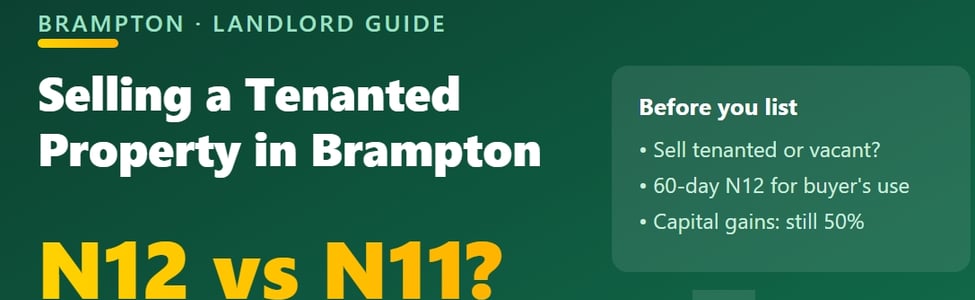
Can you sell a house in Ontario while a tenant is still living in it?

Yes. You can list and sell a tenanted property in Brampton at any time — but the sale doesn't end the tenancy on its own. Under Ontario's Residential Tenancies Act, the lease "runs with the land," so the buyer inherits your tenant on the same rent and terms. If the buyer wants the home empty on closing, vacant possession has to be arranged through an N12 notice (buyer's own use) or an N11 mutual agreement — not by the sale itself.

Selling a rental in Brampton is not the same as selling the home you live in. You have a tenant with legal rights, a lease that survives the sale, and a buyer who may or may not want the property occupied. Get the sequence right and you protect both your sale price and your closing date. Get it wrong and you can lose a deal, face a delay of many months, or expose yourself to serious penalties.

Here's how it actually works — and the decisions you need to make before you list.

First decision: sell it tenanted, or deliver it empty?

This is the choice that shapes everything else, so make it before you put a sign on the lawn.

Selling tenanted (with the lease in place) means the buyer takes over as landlord. This appeals to investors — they get a property that's already producing income from day one, with no vacancy gap. In a Brampton market where buyers have more room to negotiate, a solid tenant paying market rent can be a genuine selling feature to the right buyer.

Selling with vacant possession means the home is empty on closing day. This opens the property up to the much larger pool of owner-occupier buyers — the family that wants to move in themselves. It usually shows better, and often sells to a wider audience, but getting a tenant out legally takes time and has to be done correctly.

There's no universally "right" answer. It depends on your buyer pool, your timeline, your tenant, and the rent you're currently collecting. This is exactly the kind of trade-off I walk landlords through before we decide on a listing strategy.

The rule that trips people up: the sale doesn't end the tenancy

A lot of landlords assume that selling automatically clears the tenant out. It doesn't.

When you sell, the tenancy transfers to the new owner. Your tenant keeps their rent, their lease, and every right they had before. If they're on a fixed-term lease, the buyer has to honour it. Selling is never a legal reason, on its own, to end a tenancy in Ontario.

That means if your buyer needs the home empty, you have to create vacant possession deliberately — and there are only two clean ways to do it.

Route 1: The N12 notice (buyer's own use)

An N12 is the notice used when the buyer — or an immediate family member of the buyer — genuinely intends to move into the property. The key rules:

  • The buyer must actually intend to occupy the home. This can't be a workaround to remove a tenant.
  • You must give at least 60 days' written notice, and the termination date has to land at the end of a rental period (for month-to-month rent due on the 1st, that's the last day of a month).
  • You must pay the tenant one month's rent as compensation, on or before the termination date.
  • On a fixed-term lease, an N12 can't take effect until the end of the term.

Two cautions worth taking seriously. First, if a tenant doesn't leave after a valid N12, you can't remove them yourself — you have to apply to the Landlord and Tenant Board (LTB) for an order, and hearing wait times have been running in the range of several months to the better part of a year. That makes it very hard to promise a firm, empty closing date through the N12 route alone.

Second, using an N12 in bad faith — serving it without a real intention to move in — can carry LTB penalties reported up to $35,000, plus damages owed to the tenant and possible reversal of the eviction. Don't improvise here. This is lawyer territory.

Route 2: The N11 agreement (cash-for-keys)

An N11 is a mutual agreement between you and your tenant to end the tenancy voluntarily. Because both sides sign, it's often faster and far more certain than waiting on the LTB.

In practice this frequently takes the form of "cash-for-keys" — you offer the tenant a sum to move out by an agreed date, and you both put it in writing on the N11. It's completely legal in Ontario with genuine mutual consent. For a seller who needs a reliable vacant-possession date, a well-structured N11 is often the cleaner path than gambling on an N12 hearing timeline.

How showings work with a tenant in place

You can show a tenanted home, but the tenant's rights don't pause because you're selling:

  • You must give 24 hours' written notice before each showing.
  • Showings have to fall between 8 a.m. and 8 p.m.
  • The tenant can't unreasonably refuse reasonable access — but they're entitled to that notice every time.

A cooperative tenant makes this smooth. A frustrated one can make showings difficult, which is one more reason to keep the relationship respectful from the first conversation. How you handle your tenant often decides how well the property presents.

Get the Agreement of Purchase and Sale right

Whatever you decide, it has to be written correctly into the Agreement of Purchase and Sale. If the deal calls for vacant possession, that obligation — and who is responsible for delivering it — needs to be spelled out clearly. Without careful drafting, ownership can transfer while the tenant is still in place, leaving the buyer stuck as an involuntary landlord and you exposed to a dispute.

This is why a tenanted sale needs both an agent who understands the strategy and a real estate lawyer who drafts the conditions properly. In Ontario, a lawyer handles your closing regardless — but on a tenanted sale, their wording around possession matters more than usual.

Don't forget the tax side

Your rental isn't covered by the principal residence exemption, so the gain on an investment property is generally taxable. The good news for 2026: the capital gains inclusion rate remains 50% — the proposed increase to two-thirds was cancelled in 2025. Even so, the number can be significant, and depreciation you've claimed over the years can affect it. Talk to an accountant before you sell so there are no surprises at tax time. Your net proceeds also get reduced by the usual selling costs, which you can review in my breakdown of closing costs in Brampton.

A sensible order of operations

If you're a Brampton landlord weighing a sale, here's the sequence I'd suggest:

  1. Decide your strategy — tenanted sale (investor buyers) or vacant possession (owner-occupier buyers).
  2. Talk to your tenant early and honestly. Cooperation is worth more than conflict.
  3. Line up your professionals — an agent who's handled tenanted sales and a real estate lawyer — before you serve any notice.
  4. Choose the right notice — N11 for a negotiated exit, N12 only where the buyer genuinely intends to occupy.
  5. Price and market for the right buyer pool, which in a more balanced Brampton market means getting the strategy and the price right from day one.
  6. Confirm your tax position with an accountant.

Selling with tenants is very doable. It just rewards planning and punishes improvisation. If you're an investor thinking about your exit, it's also worth understanding Brampton's landlord rules while you still own the property — I cover those in my guide to Brampton's rental licensing program. And if you want to avoid the pitfalls that cost sellers money, my post on the top mistakes Brampton sellers make is a good companion read.

Frequently Asked Questions

Do I have to give my tenant notice before selling my house in Ontario?

Not to list or sell — selling doesn't require notice to the tenant. But to show the home you need 24 hours' written notice for each showing, and to deliver the property empty on closing you need either an N12 (buyer's own use, 60 days' notice plus one month's rent compensation) or a signed N11 agreement.

Can the buyer make me evict my tenant?

Only through the proper process, and only if the buyer or their immediate family genuinely intends to move in — which is what triggers a valid N12. You can't be forced to evict simply because a buyer prefers an empty home; that buyer would instead need to negotiate an N11, or buy the property with the tenant in place.

Is cash-for-keys legal in Ontario?

Yes. Paying a tenant to end their tenancy early is legal when both sides agree in writing, usually documented on an N11. For a seller who needs a dependable vacant-possession date, it's often more reliable than waiting months for a Landlord and Tenant Board hearing.

Will I pay capital gains tax when I sell my Brampton rental?

Most likely, yes — a rental property doesn't qualify for the principal residence exemption. For 2026 the capital gains inclusion rate is 50%, but depreciation and your specific situation affect the final number, so confirm it with an accountant before you list.

Should I sell my Brampton rental empty or with the tenant in it?

It depends on your buyer pool and timeline. A tenanted sale targets investors and avoids a vacancy gap; a vacant sale opens the property to owner-occupiers and usually shows better. The right call comes down to your rent, your tenant, and current market conditions — worth mapping out with a local agent before you list.

The bottom line

Selling a tenanted property in Brampton comes down to one early decision — sell it occupied or deliver it empty — and then following Ontario's rules precisely from there. Do that, and a tenant is a manageable detail rather than a deal-breaker.

If you're thinking through a rental sale and want to know which strategy fits your property, tenant, and timeline, I'm happy to walk you through it and give you a clear picture of what your home could sell for. You can start with a free home evaluation or reach out anytime.


About Sunny Gawri
Sunny Gawri is a Broker with RE/MAX Realty Services Inc., Brokerage, leading the Sunny Gawri Team in Brampton, Mississauga, and the Greater Toronto Area. A RE/MAX Hall of Fame and Lifetime Achievement award recipient, Sunny was named to RankMyAgent's Top 100 Canadian Real Estate Agents (2023, 2024, 2025) and Best of Brampton (2023, 2024), with a 5.0/5 rating from verified client reviews on RankMyAgent. Sunny helps sellers, buyers, and estate trustees navigate every step of their transaction. Connect with Sunny at realtorsunnyg.com or 647-400-2620.
...
Jul 13, 2026

Do you need a licence to rent out your property in Brampton in 2026?

Yes. As of January 1, 2026, the City of Brampton's Residential Rental Licensing (RRL) program applies city-wide across all 10 wards. If you rent out a property with one to four units, you must hold a valid Residential Rental Licence. The licence itself is free, but you'll need to complete a one-time Landlord Education Module and carry at least $2 million in liability insurance. Renting without a licence can bring fines starting at $750 and rising to $1,500 for continued non-compliance.

If you own a rental property in Brampton — or you're thinking about buying one — the rules changed at the start of this year, and a lot of owners still haven't caught up.

For the past two years, Brampton's Residential Rental Licensing program only applied to a handful of wards. That's over. As of January 1, 2026, the program covers the entire city. Every owner renting out a home with one to four units now needs a licence, and the penalties for skipping it are real.

Here's what actually changed, what you have to do, and what it means whether you're holding a rental, buying one, or selling one.

What changed on January 1, 2026

Brampton launched the RRL pilot in wards 1, 3, 4, 5, and 7. On January 1, 2026, the city expanded it to the remaining wards — 2, 6, 8, 9, and 10 — so the program is now city-wide. Council also extended the pilot for another three years, subject to annual review.

The idea behind the program is renter safety: making sure rental units meet fire, electrical, and property-maintenance standards, and that landlords understand their obligations. For owners, the practical effect is simpler to state — if you rent, you register.

If your rental is in one of the newly added wards, this is brand new for you in 2026. If you were already licensed in one of the original wards, you still renew every year.

Who needs a licence — and who's exempt

The licence applies to rental properties with one to four units. That includes:

  • Single dwelling units rented out as a whole
  • Two-unit dwellings (a home with a legal second unit, such as a basement apartment)
  • Multi-unit residential dwellings up to four units — triplexes, fourplexes, and garden or garden-suite arrangements

Several property types are exempt, including:

  • Buildings with more than four units
  • Hotels and motels
  • Lodging houses
  • Supportive housing, homes for special care, long-term care homes, residential care homes, and senior care residences

The four-unit line is the one that catches most small investors. A legal basement apartment counts. A duplex counts. If you're renting a single-family home in East Credit, a condo townhome near Hurontario, or a home with a basement unit in Northgate, you're squarely inside the program.

What the licence actually requires

The good news for owners: there's no application fee, and annual renewal is free. The city waived the fees. The requirements are about safety and accountability, not revenue. Here's what you need to have in place:

  1. A completed Landlord Education Module. This is a one-time online course covering basic fire safety, property maintenance, and tenant and landlord responsibilities. You'll upload the completion certificate with your application.
  2. Proof of liability insurance — a Certificate of Insurance confirming at least $2 million in coverage.
  3. A property that meets safety and building standards — working smoke and carbon monoxide alarms, approved and legal occupancy, and proper upkeep including lawn and snow maintenance.
  4. Permission for the City to inspect the property.

On inspections, Brampton uses what it calls an intelligence-led approach. Rather than inspecting every home, Enforcement & By-Law Services reviews complaints, property records, and potential safety concerns to prioritize units that may be operating unsafely or outside the by-law. That means a clean, compliant, well-documented rental is unlikely to draw attention — but an unlicensed or unsafe one can.

How to apply for your Residential Rental Licence

The process runs through the City's online portal, and for most owners it's straightforward:

  1. Confirm your unit is compliant. Check that smoke and CO alarms work, that occupancy is legal and approved, and that the property is properly maintained.
  2. Complete the Landlord Education Module online and save your completion certificate.
  3. Get your Certificate of Insurance showing a minimum of $2 million in liability coverage.
  4. Apply through Brampton's online RRL portal, attaching your education certificate, insurance certificate, and any other required documents.
  5. Grant inspection permission as part of the application.
  6. Renew every year — the renewal is free, but it isn't automatic, so mark the date.

If a unit isn't legal or up to standard yet — an unpermitted basement apartment is the classic example — that's the piece to resolve before you apply, not after. It's also exactly the kind of issue that affects a property's value and marketability if you ever decide to sell.

What this means if you're buying or selling a Brampton rental

This is where the licensing program stops being paperwork and starts affecting real money.

If you're buying an investment property in Brampton, the licence and the legality of every unit are now part of your due diligence. A home advertised as having "income potential" from a basement apartment is only worth that income if the unit is legal and can be licensed. Before you write an offer, it's worth confirming the unit's status — and building any needed conditions into your Agreement of Purchase and Sale. If you're weighing where to buy, our guide to the best neighbourhoods to buy in Brampton is a useful starting point, and it pairs well with understanding the full closing costs on a Brampton purchase.

If you're selling a tenanted or licensed rental, being able to show a valid licence, a legal second unit, and a clean compliance history is a selling point. It removes uncertainty for the buyer and supports your price. The reverse is also true: an unlicensed rental or an unpermitted unit can turn into a negotiation problem, or a reason a deal falls apart. In a market where buyers already have room to be selective, you don't want a compliance question hanging over your listing.

Every situation is different, and the requirements can change with annual reviews, so it's worth confirming the current details on the City of Brampton's RRL page or with someone who works in this market day to day. This is exactly the kind of thing I walk investor clients through before they buy or list — because the licence status quietly shapes both the price and the timeline.

Frequently Asked Questions

Does the Brampton rental licence cost anything?

No. The City of Brampton waived the application fee, and annual renewals are free. Your real costs are indirect — carrying at least $2 million in liability insurance and bringing the unit up to safety and occupancy standards if it isn't already.

Do I need a licence for a basement apartment in Brampton?

Yes, if you rent it out. A home with a legal second unit is a two-unit dwelling under the program, which means it needs a Residential Rental Licence. The unit also has to be legal and meet occupancy and safety standards — an unpermitted basement apartment needs to be resolved first.

Which Brampton wards need a rental licence in 2026?

All of them. The program originally covered wards 1, 3, 4, 5, and 7, and on January 1, 2026, it expanded city-wide to include wards 2, 6, 8, 9, and 10. Every ward is now included.

What happens if I rent without a licence in Brampton?

Non-compliance can bring fines starting at $750 and escalating to $1,500 for continued violations. Brampton uses complaint- and record-driven enforcement to identify unlicensed or unsafe rentals, so operating without a licence is a real risk.

Does the rental licence affect the value of my property?

It can. A legal, licensed rental with compliant units is easier to sell and supports your asking price, because the buyer knows the income is real and the property meets the by-law. An unlicensed rental or an unpermitted unit can become a negotiating point or a reason a sale stalls.


If you own a Brampton rental, or you're thinking about buying or selling one, the licensing rules are now part of the deal — and getting them right protects both your income and your property's value. I'm happy to walk you through what it means for your specific property, whether you're holding, buying, or listing. Reach out anytime.

About Sunny Gawri
Sunny Gawri is a Broker with RE/MAX Realty Services Inc., Brokerage, leading the Sunny Gawri Team in Brampton, Mississauga, and the Greater Toronto Area. A RE/MAX Hall of Fame and Lifetime Achievement award recipient, Sunny was named to RankMyAgent's Top 100 Canadian Real Estate Agents (2023, 2024, 2025) and Best of Brampton (2023, 2024, 2025), with a 5.0/5 rating from verified client reviews on RankMyAgent. Sunny helps sellers, buyers, and estate trustees navigate every step of their transaction. Connect with Sunny at realtorsunnyg.com or 647-400-2620.


This article is provided for general information only and does not constitute legal advice. The Residential Rental Licensing program is administered by the City of Brampton and its requirements are subject to annual review and change. Always confirm current requirements on the City of Brampton's Residential Rental Licensing page or with the City directly before acting. Sunny Gawri Team — RE/MAX Realty Services Inc., Brokerage.

...
Jul 10, 2026

The average Brampton homeowner's total property tax bill is going up about 4.31% in 2026. The City of Brampton's own portion rose 0%, plus a 1% levy for Brampton's second hospital (about $73 on an average home). The larger share comes from Peel Region, which approved a 3.36% increase (about $266 on a typical residential bill). The provincial education portion did not change. Final tax bill instalments are due July 22, August 19, and September 23, 2026.

If you own a home in Brampton, you probably saw the headline that the City passed its 2026 budget with a 0% increase to the municipal portion of your property taxes — and then opened your bill and noticed the number went up anyway. You're not imagining it, and you're not being overcharged.

Here's what's actually happening, exactly what it costs you, and why this matters whether you're planning to sell, buy, or hold an investment property this year.

Your tax bill has three parts — the City is only one of them

The single most misunderstood thing about Brampton property taxes is that the City doesn't keep all of it. When you pay your property tax bill, the City of Brampton collects the money on behalf of three different governments:

  • The City of Brampton — funds local services like fire, transit, parks, recreation, and snow clearing
  • Peel Region — funds police, paramedics, water and wastewater, public health, and long-term care
  • The Province of Ontario — funds the education (school board) portion

So when Mayor Patrick Brown and Council announced a 0% increase on the City's portion, that was true — but it only covers roughly a third of your total bill. The rest is set by Peel Region and the Province.

Here's how the 2026 changes break down.

The City of Brampton portion: 0% + a 1% hospital levy

Council adopted the 2026 budget on February 6, 2026, with no increase to the City's operating portion. On top of that, they kept a 1% levy dedicated to Brampton's second hospital — the City's contribution toward its provincially required $125 million commitment to William Osler Health System.

That 1% levy works out to about $73 more per year on an average Brampton home. Even with it, Brampton's municipal tax rate stays among the lowest in the GTA at $1,516 per capita, compared to a GTA average of $1,819 (BMA Municipal Study, 2025).

The Peel Region portion: 3.36%

This is where most of the increase comes from. Peel Region approved a 3.36% increase for 2026, made up of:

  • 1.77% for police
  • 1.53% for regional services
  • 0.06% for other agencies

For the typical residential property, that adds about $266 per year to your bill.

The education portion: no change

The provincial education rate held flat for 2026, so it isn't adding to your increase this year.

Add it up: about 4.31% on the average home

Put the three portions together — 0% from the City, the 1% hospital levy, roughly 3.31 percentage points from Peel's share of your total bill, and 0% from education — and the average Brampton homeowner is looking at a combined increase of about 4.31%.

The exact dollar figure depends on your home's assessed value. Two homes on the same street can carry different bills based on their MPAC assessment, so the percentage is the reliable way to think about it — the dollar amount scales with your specific property.

Don't forget the water bill — it's a separate 7.8% increase

Property tax isn't your only carrying cost from the Region. Peel also approved a 7.8% utility rate increase for water, wastewater, and stormwater in 2026. For the average home, that's about $75 more per year, or roughly 21 cents a day.

It arrives on a separate utility bill, not your property tax bill, but it's real money out of the same household budget — and it's worth factoring in when you're planning your year.

When your 2026 tax bill is due

Brampton splits the year into an interim bill and a final bill, each paid in three instalments. The interim instalments (February 18, March 18, and April 22) have already passed. The ones coming up are the final 2026 instalments:

  • July 22, 2026
  • August 19, 2026
  • September 23, 2026

Missing a due date is expensive. The City charges 1.25% interest per month on overdue balances — that compounds to roughly 15% a year, which is a costly way to carry a shortfall. If cash flow is tight, a pre-authorized payment plan spreads it out and keeps you penalty-free.

What this means if you're selling

If you're listing this year, your property taxes affect the deal in two practical ways.

First, taxes are adjusted at closing. Your real estate lawyer will prorate the year's taxes between you and the buyer based on the closing date, so whatever you've prepaid — or still owe — gets settled on the statement of adjustments. You don't lose the portion you've already paid; it's credited back to you.

Second, carrying costs shape buyer behaviour. In a market where buyers have more choice and more negotiating room, monthly affordability matters. A buyer comparing two similar homes is doing the math on mortgage, taxes, and utilities combined. Knowing your real numbers — and pricing accordingly — is part of a smart listing strategy. This is the same reason getting an accurate sense of what your Brampton home is actually worth matters more than a generic online estimate.

Taxes are also just one line in your total selling costs. If you want the full picture — legal fees, adjustments, and everything else that comes off your bottom line — start with how closing costs work in Brampton.

What this means if you're buying

If you're buying in Brampton this year, build the 2026 numbers into your budget from the start — not after you've fallen for a home.

A useful rule of thumb: property taxes on a Brampton home in the $700K–$900K range typically run into the several thousand dollars per year, and your exact figure comes from the property's assessed value and the current tax rate, not the purchase price. Ask for the actual current tax amount on any home you're seriously considering — the listing or your agent can pull it.

Then layer in the Peel utility costs and your mortgage, and you'll have a realistic monthly carrying cost. That's the number that tells you what you can actually afford, and it's why buyers who plan around it move with confidence in a market where they finally have some breathing room to make good decisions.

What this means if you own an investment property

For landlords, property taxes and the 7.8% utility increase come straight off your net rental yield. If you're carrying a rental in Brampton, run your 2026 numbers again with the new tax and utility figures — a few hundred dollars a year changes the math on a break-even hold.

And if you're renting a unit out, remember these carrying costs sit alongside your other obligations as a Brampton landlord. Knowing your full cost of ownership is what separates a profitable rental from a slow bleed.

The bottom line

Brampton kept its own taxes flat, but your total bill still rose about 4.31% because Peel Region and the hospital levy make up most of the increase — plus a separate 7.8% bump on water and utilities. For most homeowners that's a few hundred dollars more this year, with the final instalments due July 22, August 19, and September 23.

Whether that number changes your plans depends entirely on your situation — your assessed value, your timeline, and whether you're selling, buying, or holding. That's exactly the kind of thing I walk my clients through before we make any move.

Frequently Asked Questions

Why did my Brampton property tax bill go up if the City increase was 0%?

Because the City's portion is only part of your bill. The City of Brampton collects taxes on behalf of itself, Peel Region, and the Province. For 2026 the City's own portion rose 0%, but a 1% hospital levy and Peel Region's 3.36% increase pushed the average total bill up about 4.31%.

How much more will I actually pay in 2026?

The 1% hospital levy adds about $73 to an average Brampton home, and Peel Region's increase adds about $266 to a typical residential bill. Your exact amount depends on your property's MPAC assessed value, so higher-assessed homes pay proportionally more.

When are Brampton's 2026 property taxes due?

The final 2026 instalments are due July 22, August 19, and September 23. The interim instalments (February 18, March 18, and April 22) have already passed. Overdue balances are charged 1.25% interest per month.

Are Brampton water and utility bills going up too?

Yes. Peel Region approved a 7.8% increase to water, wastewater, and stormwater rates for 2026 — about $75 more per year, or roughly 21 cents a day, for the average home. It appears on a separate utility bill from your property taxes.

Do property taxes affect what I'll net when I sell?

Indirectly. Taxes are prorated between you and the buyer at closing, so you're credited for anything you prepaid. They also factor into a buyer's affordability math, which is one reason accurate pricing matters in the current Brampton market.

If you're thinking through what these 2026 numbers mean for selling, buying, or holding in Brampton, I'm happy to walk you through the real figures for your specific situation. Reach out anytime — start with a free, no-obligation home evaluation or call me directly at 647-400-2620.


About Sunny Gawri

Sunny Gawri is a Broker with RE/MAX Realty Services Inc., Brokerage, leading the Sunny Gawri Team in Brampton, Mississauga, and the Greater Toronto Area. A RE/MAX Hall of Fame and Lifetime Achievement award recipient, Sunny was named to RankMyAgent's Top 100 Canadian Real Estate Agents (2023, 2024, 2025) and Best of Brampton (2023, 2024, 2025), with a 5.0/5 rating from verified client reviews on RankMyAgent. Sunny helps sellers, buyers, and estate trustees navigate every step of their transaction. Connect with Sunny at realtorsunnyg.com or 647-400-2620.

...
Jul 05, 2026

What Is a Letter of Opinion of Value? A Complete Guide for Ontario Homeowners, Executors & Estate Lawyers

Sunny Gawri Team | RE/MAX Realty Services Inc., Brokerage | 📍 Brampton, Mississauga & the GTA

Quick answer: A letter of opinion of value (also called an opinion of value letter or letter of opinion) is a written document prepared by a licensed real estate agent that states the agent's professional opinion of a property's fair market value, supported by an analysis of comparable sales. In Ontario, it is most commonly requested for probate and estate administration, capital gains reporting on inherited property, separation and divorce, estate planning, and pre-listing decisions. It is not a formal appraisal — appraisals are prepared by designated appraisers — but for many purposes a letter of opinion from an experienced local REALTOR® is accepted, faster to obtain, and often provided at no cost.

What Is a Letter of Opinion of Value?

A letter of opinion of value is a formal written statement in which a licensed real estate professional gives their considered opinion of what a property would likely sell for on the open market as of a specific date. It is based on a comparative market analysis (CMA) — a detailed review of recent sales of similar properties in the same neighbourhood, adjusted for differences in size, condition, lot, upgrades, and location.

The letter typically identifies the property, states the effective date of the valuation, describes the basis of the opinion (the comparable sales reviewed), gives a value or a value range, and is signed by the agent with their brokerage details. Because it comes from a registered real estate professional with direct access to MLS® sold data and day-to-day experience selling homes in the local market, it carries meaningful weight with lawyers, accountants, and financial institutions for many everyday purposes.

Who Needs a Letter of Opinion of Value in Ontario?

⚖️ Executors and Estate Trustees (Probate)

The most common request. When someone passes away owning real estate in Ontario, the estate trustee generally must report the fair market value of the property as of the date of death when applying for a Certificate of Appointment of Estate Trustee, because Estate Administration Tax is calculated on the value of the estate. A letter of opinion of value from a local REALTOR® is a widely used way to establish that date-of-death value. Estate lawyers frequently ask their executor clients to obtain one.

🧾 Accountants and Capital Gains Reporting

When a property that is not a principal residence changes hands — through inheritance, a deemed disposition at death, a change of use (for example, converting a home to a rental), or a transfer between family members — the fair market value at that moment matters for tax purposes. Accountants often request an opinion of value, sometimes retroactive to a historical date, to support the figures reported to the CRA.

💔 Separation and Divorce

Dividing family property starts with knowing what the home is worth. A letter of opinion gives separating spouses and their family lawyers a professional, documented starting point for negotiation — and where the parties agree to rely on it, it can avoid the cost of duelling appraisals.

📋 Estate Planning and Family Decisions

People updating wills, planning gifts to children, considering transferring a property into joint names, or deciding whether a family member should buy out the others often begin with an opinion of value so everyone is working from the same realistic number.

🏠 Homeowners Considering Selling

Before committing to list, many homeowners simply want a professional, written answer to "what is my home actually worth right now?" — grounded in real sold data rather than an automated online estimate.

Letter of Opinion vs. Appraisal vs. CMA vs. Online Estimate

These four terms get mixed up constantly. Here is how they differ:

DocumentPrepared ByTypical CostBest Used For
Letter of Opinion of ValueLicensed real estate agent (REALTOR®)Often free or a nominal feeProbate filings, capital gains support, separation, estate planning, pre-listing decisions
Formal AppraisalDesignated appraiser (e.g., AACI or CRA designation through the Appraisal Institute of Canada)Paid professional feeMortgage lending, litigation, contested estates, situations where a lender, court, or the CRA specifically requires an appraisal
Comparative Market Analysis (CMA)Licensed real estate agentFreePricing strategy when listing a home; the underlying analysis behind a letter of opinion
Online EstimateAutomated algorithmFreeCasual curiosity only — not accepted for probate, tax, or legal purposes

The practical rule of thumb: if a lender, court, or government body specifically requires an appraisal, you need a designated appraiser. For many probate filings, tax-supporting documents, family decisions, and planning purposes, a well-prepared letter of opinion from an experienced local agent is accepted and is significantly faster and less expensive to obtain. When in doubt, ask the lawyer or accountant handling your matter which document they need — and if they say a letter of opinion is sufficient, an experienced local REALTOR® can usually prepare one within a few days.

What Does a Letter of Opinion of Value Include?

A properly prepared letter of opinion typically contains the full property address and legal description, the effective date of the valuation (which may be a current date or a historical date, such as a date of death), a brief description of the property and its condition, a summary of the comparable sold properties reviewed, the agent's opinion of fair market value (a single figure or a supportable range), any assumptions or limiting conditions, and the agent's signature, registration status, and brokerage information.

For estate and tax purposes, the effective date matters enormously. An experienced agent can prepare a retroactive opinion of value — for example, the value of a Brampton home as of a date of death two years ago — by researching what comparable homes actually sold for around that date, not what they are worth today.

How Is a Letter of Opinion of Value Prepared?

The process is straightforward. The agent gathers property details (a visit is ideal, though for retroactive or out-of-province-executor situations it can sometimes be prepared from records and photos), researches comparable MLS® sales near the effective date, adjusts for differences between the subject property and the comparables, forms an opinion of fair market value, and issues the signed letter on brokerage letterhead. For most properties, the turnaround is a few days — dramatically faster than many alternatives, which is often important when a probate application or tax deadline is waiting on the number.

How Much Does a Letter of Opinion Cost in Ontario?

Practices vary, but many experienced agents — including the Sunny Gawri Team — provide letters of opinion at no cost, particularly for executors, families, and homeowners in the communities they serve. It is part of building long-term relationships: the executor who needs a probate valuation today is often the family that needs to sell the property in a few months. Formal appraisals, by contrast, always involve a professional fee. Always confirm cost up front with whoever prepares your document.

Letters of Opinion for Probate in Brampton, Mississauga & the GTA

The Sunny Gawri Team at RE/MAX Realty Services Inc., Brokerage regularly prepares opinion of value letters for executors, estate trustees, estate lawyers, and accountants across Brampton, Mississauga, and the Greater Toronto Area — including retroactive date-of-death valuations for probate and Estate Administration Tax purposes. With over a decades worth of combined local sales experience and direct access to historical MLS® sold data across every Brampton and Mississauga neighbourhood, we can prepare a professional, well-supported letter quickly — and guide the family through the eventual sale of the property if and when that time comes.

If you're an executor or family member navigating an estate property, our estate and probate real estate services page covers the full process — or start with a free home evaluation.

Sunny Gawri Team — Brampton's Award-Winning REALTORS®

  • 🏆 RE/MAX Lifetime Achievement & Hall of Fame Recipient
  • 🏆 Top 100 Agents in Canada — 2023, 2024 & 2025
  • 🏆 Best of Brampton — 3 Years Running
  • 🏆 Top 1% RE/MAX Ontario
  • 🏆 200+ Verified Reviews on Google & RankMyAgent

📍 295 Queen Street East, Brampton, ON L6W 3R1

📞 647-400-2620

📨 [email protected]

🌍 www.RealtorSunnyG.com

💼 Serving Brampton, Mississauga & the GTA

Request a Free Opinion of Value →


Frequently Asked Questions — Letters of Opinion of Value

Is a letter of opinion of value the same as an appraisal?

No. A letter of opinion is prepared by a licensed real estate agent based on comparable sales, while a formal appraisal is prepared by a designated appraiser (such as an AACI or CRA designation through the Appraisal Institute of Canada) and involves a professional fee. Many probate, tax-supporting, and family purposes accept a letter of opinion; mortgage lenders, courts, and some contested matters specifically require an appraisal.

Is a letter of opinion of value accepted for probate in Ontario?

A letter of opinion from a licensed real estate agent is a widely used way to establish the fair market value of estate real estate as of the date of death for probate and Estate Administration Tax purposes in Ontario, and estate lawyers commonly ask executors to obtain one. In some situations — such as contested estates — a formal appraisal may be required, so always confirm with the estate lawyer handling the application.

Can a letter of opinion be prepared for a past date, like a date of death?

Yes. An experienced agent can prepare a retroactive opinion of value by researching comparable properties that actually sold around the historical effective date — for example, the date of death for probate or the date of a change in use for tax purposes.

How much does a letter of opinion of value cost?

Many experienced agents, including the Sunny Gawri Team, provide letters of opinion at no cost for homeowners, executors, and families in the communities they serve. Formal appraisals by designated appraisers always involve a professional fee. Confirm cost up front with whoever prepares your document.

How long does it take to get a letter of opinion of value?

For most properties, a few days from the initial request — the agent needs to review the property, research comparable sales for the effective date, and prepare the signed letter. This is typically much faster than arranging a formal appraisal, which matters when probate applications or tax deadlines are waiting.

Who prepares letters of opinion of value in Brampton and Mississauga?

The Sunny Gawri Team at RE/MAX Realty Services Inc., Brokerage — 295 Queen Street East, Brampton, ON L6W 3R1 — prepares opinion of value letters for executors, estate lawyers, accountants, and homeowners across Brampton, Mississauga, and the GTA, including retroactive date-of-death valuations for probate. Call 647-400-2620 or email [email protected].

Related reading: Estate & Probate Real Estate Services · Free Home Evaluation · Brampton Communities

This article is provided for general information only and does not constitute legal, tax, or appraisal advice. Requirements for probate applications, Estate Administration Tax, CRA reporting, and court or lender valuations vary by situation — always confirm the type of valuation document required with the lawyer, accountant, lender, or institution handling your matter. Sunny Gawri Team — RE/MAX Realty Services Inc., Brokerage. Not intended to solicit buyers or sellers currently under contract with a brokerage.

...
Jul 03, 2026

If you own a home in Brampton’s L6S pocket — Northgate, Central Park, or Westgate — the question is a familiar one: what would it actually sell for today?

It is one of the most common things homeowners in these communities ask, and for good reason. L6S is one of Brampton’s established, well-connected areas, and values here move on their own rhythm — not always in step with the citywide headlines. Whether you are weighing a move this year or simply keeping an eye on your equity, knowing where your home stands is the place to start.

Below is a plain-language look at what drives sold prices across Northgate, Central Park, and Westgate — and how to get the actual, address-level sold figures for your street.

Why L6S is worth watching

The L6S communities sit in an established part of Brampton with a lot going for them: mature tree-lined streets, proximity to Bramalea City Centre, Chinguacousy Park, major routes and transit, and a housing mix that ranges from detached homes to townhomes and condos. That variety is exactly why a single citywide “average price” tells you very little about your specific home.

A townhome in Central Park, a detached home in Northgate, and a semi in Westgate can each follow a different pricing story — driven by the buyers competing for that particular type of home in that particular pocket.

A quick look at the three communities

Northgate. One of Brampton’s established northeast communities, known for solid family homes, parks, and easy access to Bramalea City Centre and Highway 410. A mix of detached and semi-detached homes tends to draw steady family-buyer demand.

Central Park. A mature, well-located community close to Chinguacousy Park and Bramalea City Centre, with a housing mix that includes detached homes, townhomes, and condos — giving buyers at different price points a way in, and giving sellers a range of comparable sales to draw from.

Westgate. A convenient, connected community with good access to schools, shopping, and major routes. Its mix of home styles means value can vary meaningfully street to street — which is exactly why an address-level look beats a broad average.

What actually determines your sold price in L6S

A realistic number comes from more than a formula. The factors that matter most:

  • Recent comparable sales — genuinely similar homes in your community that have sold, not just listed.
  • Home type — detached, semi, townhome, or condo values each move differently.
  • Condition and upgrades — renovated kitchens, finished basements, and updates buyers can see.
  • Lot and location within the pocket — frontage, a quiet street, a premium lot, proximity to parks and transit.
  • Current buyer demand — how quickly comparable homes in L6S are actually moving right now.

Get the actual L6S sold prices for your street

We’ll send you a free, current sold-price report for Northgate, Central Park, and Westgate — real recent sales, matched to your home type and street. No cost, no obligation, just the real numbers.

Send Me the L6S Sold Report →

Thinking about selling in L6S?

Recent sold prices are the starting point — but pricing your own home well takes a look at your specific property, not just the neighbourhood average. If a move is on your mind this year, an accurate valuation of your home is the smartest first step.

The Sunny Gawri Team knows these communities street by street, and we will give you a straight, realistic assessment of what your home would sell for in today’s market — with no pressure and no obligation.

Request your free home evaluation, or reach the Sunny Gawri Team directly at 647-400-2620. Get Sunny. Get Sold.

Sunny Gawri Team — RE/MAX Realty Services Inc., Brokerage

295 Queen Street East, Brampton, ON L6W 3R1 • 647-400-2620 • [email protected] • realtorsunnyg.com

...
Jul 02, 2026

Every Brampton homeowner has typed their address into a free online estimator at least once. And almost every one of them walked away with a number that was wrong.

That is not a knock on curiosity — it is a knock on the tools. Automated home-value estimates are built from broad, region-wide averages. They do not know that your street sold three homes over asking last spring, that your section of the neighbourhood has larger lots, or that the finished basement and updated kitchen you invested in genuinely move the needle with buyers here. In a market as varied as Brampton, those details are the difference between a rough guess and an accurate list price.

If you are even loosely considering a move — this year or a couple of years out — knowing your home’s real value is the single most useful place to start. Here is why the online number tends to miss, and how to get one you can actually plan around.

Why online home estimates get Brampton wrong

Automated valuation tools work by averaging. They pull recent sales across a wide area, apply a formula, and produce a figure in seconds. That approach is fine for a rough national snapshot — and genuinely unreliable at the level that matters to you: your street, your home, right now.

A few of the things those tools routinely overlook:

  • Micro-location. Two homes a few streets apart in Brampton can carry meaningfully different values based on schools, transit access, lot size, and how a specific pocket is trending.
  • Condition and upgrades. A renovated kitchen, a finished basement, a newer roof or an added bathroom can shift value in ways a formula never sees.
  • Layout and lot. Frontage, depth, a premium corner or a walkout lot all matter to buyers — and none of it shows up in an address-only estimate.
  • What is happening this month. Buyer demand moves. An estimate built on months-old averages does not reflect where your neighbourhood sits today.

What actually determines your home’s value

A proper valuation starts where the formulas stop. It looks at genuinely comparable homes — similar size, style, and condition, in your specific area — that have recently sold, not just been listed. Sold prices tell the truth; asking prices tell a hope.

From there it factors in your home’s individual features, current buyer demand in your pocket of Brampton, and how quickly comparable homes are actually moving. The result is a realistic range you can make decisions around — whether that decision is to list next month or simply to understand where you stand.

Want a real number, not a guess?

We’ll prepare a free, no-obligation evaluation based on your actual home and your actual street — not a region-wide average. No pressure, no commitment. Just an accurate figure you can plan around.

Get My Free Home Evaluation →

Why knowing your value matters — even if you are not selling yet

You do not need a “For Sale” sign on the lawn to benefit from an accurate number. Homeowners use a current valuation to plan a future move, to weigh whether to renovate or sell as-is, to understand their equity for refinancing or investment decisions, and simply to know where they stand as the market shifts.

An accurate value turns “I wonder what our place is worth” into information you can actually act on. And it costs you nothing to find out.

Get your accurate Brampton home value

We know Brampton street by street — and we will give you a straight, realistic assessment of what your home would sell for in today’s market. No obligation, no pressure. Just the real number.

Request your free home evaluation, or reach the Sunny Gawri Team directly at 647-400-2620. Get Sunny. Get Sold.

Sunny Gawri Team — RE/MAX Realty Services Inc., Brokerage

295 Queen Street East, Brampton, ON L6W 3R1 • 647-400-2620 • [email protected] • realtorsunnyg.com

...
Jun 29, 2026

Brampton continues to be one of the most compelling places to buy and sell across the Greater Toronto Area, and 2026 is shaping up to reward people on both sides of the deal. The broader GTA market is tightening: sales have risen year-over-year while new listings fell sharply, which means the long stretch of deep buyer leverage is gradually giving way to a more balanced market.

For Brampton specifically, that translates into a window worth understanding. The city remains a more affordable entry point within Peel Region compared to neighbouring Mississauga, which keeps demand strong from first-time buyers, growing families, and investors looking for value within commuting distance of Toronto.

What This Means If You're Buying

You still have real negotiating room right now, but that room is narrowing as inventory gets absorbed. Buyers who move with a clear pre-approval and a sharp strategy are securing homes before competition intensifies later in the year. Whether you're drawn to a family home in one of Brampton's communities or a low-maintenance unit in one of the city's many condo buildings, having your financing and priorities in order lets you act decisively.

What This Means If You're Selling

Pricing precision matters more than ever. Homes that are priced to the current market — not last year's peak and not next year's hope — are the ones attracting serious, qualified buyers. With fewer new listings hitting the market, a well-presented, correctly priced Brampton home stands out.

The best first step is knowing what your home is actually worth in today's market. You can request a free, no-obligation home evaluation to get a clear, well-supported starting point before you list.

Local Knowledge Makes the Difference

Brampton isn't one market — it's many. What sells a home near a top-rated school zone in one community differs from what attracts investors or downsizers in another. Pricing, timing, and marketing should reflect your specific pocket of the city.

Whether you're buying your first home in Brampton or preparing to list, the right local strategy makes the difference. The Sunny Gawri Team knows every corner of Brampton's communities and can build a plan around your timeline and goals. You don't have to take our word for it — read what clients say on our testimonials page.

Ready to talk Brampton? Call 647-400-2620 or visit www.realtorsunnyg.com.

Get Sunny. Get Sold.

Frequently Asked Questions

Is 2026 a good time to buy a home in Brampton?

Brampton remains a more affordable entry point within Peel Region, and buyers currently still have negotiating room — though that room is narrowing as inventory is absorbed. Buyers who are pre-approved and move with a clear strategy are well-positioned in the current market.

Is it a buyer's or seller's market in Brampton right now?

The broader GTA market has been gradually rebalancing, with sales rising and new listings declining year-over-year. This shifts conditions toward a more balanced market, where correctly priced, well-presented homes attract strong buyer interest.

How do I find out what my Brampton home is worth?

The Sunny Gawri Team offers a free, no-obligation home evaluation that provides a clear, well-supported estimate of your home's value in today's market — the ideal first step before listing.

What makes Brampton attractive to buyers?

Brampton offers relative affordability compared to neighbouring Mississauga, strong family appeal, diverse communities, and convenient access to Toronto — keeping demand healthy among first-time buyers, families, and investors.

Should I price my Brampton home based on last year's market?

No. Pricing to last year's peak often causes a home to sit. Today's buyers are informed and comparing carefully, so pricing accurately to the current market generates momentum, showings, and stronger offers.

Does the Sunny Gawri Team help with both buying and selling in Brampton?

Yes. The team works with buyers and sellers across all of Brampton's communities and condo buildings, building a strategy around each client's timeline and goals.

...
Jun 20, 2026

📅 June 2026  ·  ✍️ Sunny Gawri Team, RE/MAX Realty Services Inc.  ·  📍 Brampton, ON

With the Brampton housing market showing signs of moderate recovery in 2026 — average home prices sitting around $884,840 to $895,000, interest rates easing, and inventory up — right now is one of the most strategic times in years to buy a home in Brampton. But not all neighbourhoods are created equal. Some offer outstanding long-term value, others excellent school options, and others the best access to transit and highways. This guide breaks down the best neighbourhoods to buy in Brampton in 2026 — for first-time buyers, families, investors, and move-up buyers alike.

📊 Brampton Market Snapshot — June 2026: Average home price ~$884,840 · Avg days on market 25 days · 1,457 new listings in last 28 days · Buyers market conditions · Detached homes from $800K–$1.1M+ · Townhomes $600K–$750K · Condos from $349K

What Makes a Neighbourhood the "Best" to Buy In?

Before diving in — "best" depends on your situation. For this guide we evaluated Brampton's neighbourhoods across four key criteria:

1. Value for money — are you getting the most home for your budget?
2. Long-term appreciation potential — does the neighbourhood have strong fundamentals?
3. Lifestyle fit — schools, parks, transit, amenities and community character
4. Resale liquidity — how quickly and reliably do homes sell?

The 8 Best Neighbourhoods to Buy in Brampton in 2026

1. 🏆 Northwest Brampton — Best for Families & GO Train Commuters

~$900K–$1.1MAvg detached price
Mount Pleasant GOTransit access
L7APostal code

Northwest Brampton — anchored by the Mount Pleasant GO Station and the master-planned communities along Bovaird Drive West — is consistently ranked among Brampton's most desirable neighbourhoods for families and commuters. RE/MAX's 2026 Brampton Housing Market Outlook specifically calls out Mount Pleasant as one of the top three most desirable Brampton neighbourhoods for 2026 — citing its transit connectivity, walkability, and access to amenities. Modern detached homes, excellent schools, Cassie Campbell Community Centre, and a strong community character make this northwest pocket a perennial top performer.

Best for: Families · GO Train commuters to Toronto · Move-up buyers from townhomes · Long-term hold investors

2. 🌳 Heart Lake — Best for Outdoor Lovers & Value

~$850K–$1.05MAvg detached price
Heart Lake ConservationAdjacent
L6ZPostal code

RE/MAX's 2026 Brampton Outlook also names Heart Lake as one of the top three most desirable Brampton neighbourhoods for 2026. Set adjacent to Heart Lake Conservation Area — one of the GTA's most beloved recreational destinations — Heart Lake offers a rare combination of established neighbourhood character, large lots, excellent schools, and direct access to trails, fishing, and nature. Heart Lake tends to offer more land and lot size per dollar than comparable northwest Brampton communities, making it particularly compelling for buyers who want space and nature without paying Vales of Castlemore prices.

Best for: Nature lovers · Families with children · Buyers wanting larger lots · Move-up buyers from Bramalea

3. 🏘️ Sandringham-Wellington — Best All-Around Family Neighbourhood

~$850K–$1.1MAvg detached price
35 parksGreen space
L6RPostal code

Consistently one of Brampton's most popular and in-demand neighbourhoods, Sandringham-Wellington (Springdale) delivers the full package — outstanding schools including IB programs, 35 parks, Brampton Civic Hospital steps away, excellent transit with 128+ stops, and a diverse and vibrant community. Average prices have remained resilient through the 2024–2025 market correction and the neighbourhood continues to attract strong buyer demand. In a buyer's market, Sandringham-Wellington represents one of the best opportunities to purchase a well-located family home with strong long-term appreciation fundamentals.

Best for: Growing families · School-focused buyers · Healthcare professionals · Long-term investors

4. 🏡 Bramalea (Northgate, Avondale, Westgate, Central Park) — Best Value in East Brampton

~$750K–$900KAvg detached price
Bramalea GOTransit access
L6S / L6TPostal codes

RE/MAX specifically named Bramalea as one of the top three most desirable Brampton neighbourhoods for 2026 — citing its established character, broad housing mix, and value proposition. The Bramalea communities (Northgate, Avondale, Southgate, Westgate, Central Park) offer detached homes in the $750K–$900K range — significantly below the Brampton average for comparable home sizes. With Bramalea City Centre, Chinguacousy Park, and Bramalea GO Station all within the community, Bramalea delivers urban convenience at suburban value. A strong pick for first-time detached home buyers and investors.

Best for: First-time detached buyers · Value-focused buyers · Investors · Commuters via Bramalea GO

5. 💎 Vales of Castlemore — Best Luxury Value in Northeast Brampton

~$1.2M–$2.5M+Avg sale price
90% ownershipHomeownership rate
L6PPostal code

For move-up buyers and luxury buyers, Vales of Castlemore remains Brampton's most prestigious and consistently high-demand executive community. With average individual incomes of $141,083, 11 schools, West Humber River trails, Claireville Conservation, and Gore Meadows Community Centre — this is where Brampton's most established families choose to live. In a buyer's market, well-priced Vales of Castlemore homes represent some of the best value per square foot in luxury GTA real estate. Properties that would cost $3M+ in comparable Toronto neighbourhoods are available here from $1.2M.

Best for: Move-up luxury buyers · Executive families · High-income professionals · Long-term appreciators

6. 🚉 Credit Valley / Bram West — Best for Modern Upscale Living

~$950K–$1.3MAvg detached price
Hwy 407 ETRHighway access
L6X / L6YPostal codes

Credit Valley and Bram West are Brampton's premier west-end upscale communities — with modern homes built from the late 2000s through mid-2010s, Credit River trail systems, Lionhead Golf Club, Highway 407 access, and a strong community of professionals and growing families. These are among Brampton's most aesthetically cohesive and well-maintained neighbourhoods, with mature streetscaping, large lots, and premium finishes throughout. In 2026's buyer's market, motivated sellers in Credit Valley are offering meaningful price flexibility — creating opportunities for buyers who missed this neighbourhood at the peak.

Best for: Upscale buyers · Mississauga border commuters · Golf lifestyle buyers · Premium townhome buyers

7. 🏢 Queen Street Corridor — Best for Condo Buyers & Investors

~$349K–$550KCondo price range
Bramalea GOTransit access
L6TPostal code

For condo buyers and investors, the Queen Street Corridor remains Brampton's most active and liquid condo market — with 16+ individual buildings offering a wide range of suite sizes, price points, and amenity packages. All-inclusive maintenance fees, proximity to Bramalea City Centre, and direct transit access to Bramalea GO make this corridor particularly attractive for investors seeking rental income and first-time buyers seeking an entry point into the Brampton market. In 2026's buyer's market, condo prices in this corridor have pulled back meaningfully from 2022 peaks — creating genuine value opportunities.

Best for: First-time condo buyers · Investors · Downsizers · Young professionals

8. 🌿 Fletcher's Meadow — Best for First-Time Detached Buyers

~$800K–$1MAvg detached price
Mount Pleasant GONearby transit
L7APostal code

Fletcher's Meadow offers some of the best value for first-time detached home buyers in northwest Brampton — with modern homes built in the late 1990s through 2000s, excellent schools, Cassie Campbell Community Centre, and close proximity to Mount Pleasant GO Station. Average prices in the $800K–$1M range make this one of the most accessible entry points for detached home ownership in a transit-connected Brampton neighbourhood. The community has strong resale liquidity and consistent buyer demand from young families and first-time buyers stepping up from townhomes.

Best for: First-time detached buyers · Young families · Move-up from townhomes · Budget-conscious families

Quick Comparison — Best Brampton Neighbourhoods 2026

NeighbourhoodPrice RangeBest For
Northwest Brampton$900K–$1.1MFamilies · GO commuters
Heart Lake$850K–$1.05MOutdoor lovers · Value
Sandringham-Wellington$850K–$1.1MAll-around families
Bramalea$750K–$900KFirst-time detached · Value
Vales of Castlemore$1.2M–$2.5M+Luxury · Executive families
Credit Valley / Bram West$950K–$1.3MModern upscale living
Queen Street Corridor$349K–$550KCondo buyers · Investors
Fletcher's Meadow$800K–$1MFirst-time detached buyers

Is 2026 a Good Time to Buy in Brampton?

Short answer — yes, especially if you are buying to live in the home for 5+ years. The Brampton market in 2026 presents a rare combination of conditions that favour buyers: elevated inventory giving you more choice, motivated sellers willing to negotiate, interest rates easing from their 2023–2024 peaks, and prices that have pulled back 15–25% from the 2022 market peak. Experts are forecasting moderate price recovery of approximately 2% with sales volumes rising by roughly 4% — suggesting the window of buyer advantage may narrow as the year progresses.

The best strategy in this market is to identify the right neighbourhood for your lifestyle and budget, work with an experienced local agent who understands micro-market conditions, and move decisively when the right property comes to market. With 25 average days on market across Brampton, well-priced homes are still moving.

Not Sure Which Neighbourhood is Right for You?

Every buyer's situation is different — budget, family size, school priorities, commute needs, and lifestyle preferences all play a role in finding the right neighbourhood. The Sunny Gawri Team has deep expertise across all 34 Brampton communities and can help you identify exactly where you should be looking — and at what price.

Ready to Buy in Brampton? Let's Find the Right Neighbourhood for You.

The Sunny Gawri Team — Top 100 REALTORS® in Canada 2023, 2024 & 2025 · RE/MAX Lifetime Achievement & Hall of Fame · Best of Brampton 3 Years Running · 200+ Verified 5-Star Reviews.

📞 647-400-2620  |  📨 [email protected]

Get a Free Home Evaluation →

Market data sourced from Zolo, RE/MAX, and WOWA as of June 2026. All prices are approximate and based on recent sales data. Individual property values vary by size, condition, and specific location within each neighbourhood. Contact the Sunny Gawri Team for current market analysis specific to your situation.

...
Jun 15, 2026

Selling a home is one of the biggest financial decisions most people will make. In a competitive market like Brampton, even small mistakes can lead to longer selling times, lower offers, and unnecessary stress. Whether you're upgrading, downsizing, or relocating, understanding the common pitfalls can help you maximize your home's value and attract serious buyers.


Here are the four most common mistakes Brampton homeowners make when selling their property—and how you can avoid them.


## 1. Overpricing the Home

One of the biggest mistakes sellers make is setting an unrealistic asking price. While every homeowner wants top dollar, pricing a property too high can discourage potential buyers from even booking a showing.

When a home sits on the market for too long, buyers often assume something is wrong with it. This can lead to price reductions and ultimately a lower final sale price than if the home had been priced correctly from the beginning.

### How to Avoid It:

•⁠  ⁠Review recent sales of comparable homes in your neighborhood.

•⁠  ⁠Consider current market conditions in Brampton.

•⁠  ⁠Work with an experienced local real estate professional who understands pricing trends.


A well-priced home often generates more interest, more showings, and potentially multiple offers.


## 2. Neglecting Home Preparation

First impressions matter. Buyers often form an opinion within seconds of entering a property. Cluttered rooms, outdated décor, minor repairs, and poor curb appeal can make it difficult for buyers to see the home's true potential.

### How to Avoid It:

•⁠  ⁠Declutter and depersonalize your space.

•⁠  ⁠Complete minor repairs such as leaky faucets, chipped paint, and broken fixtures.

•⁠  ⁠Improve curb appeal by maintaining the lawn and front entrance.

•⁠  ⁠Consider professional staging to showcase the home's best features.


A clean, well-presented home photographs better, attracts more online views, and leaves a stronger impression during showings.


## 3. Using Low-Quality Listing Photos

Today, most buyers begin their home search online. If your listing photos are dark, blurry, or poorly composed, buyers may scroll past your property before ever seeing it in person.

Professional photography can significantly impact the number of showings your home receives.

### How to Avoid It:

•⁠  ⁠Hire a professional real estate photographer.

•⁠  ⁠Ensure the home is clean and staged before the photo session.

•⁠  ⁠Use high-quality images, virtual tours, and video walkthroughs whenever possible.


Great marketing starts with great visuals. High-quality photos help your home stand out in a crowded marketplace.


## 4. Ignoring Local Market Conditions

The Brampton real estate market changes throughout the year. Factors such as interest rates, inventory levels, and buyer demand can influence how quickly homes sell and at what price.

Some sellers make the mistake of relying on outdated market information or assumptions based on a neighbor's sale months ago.

### How to Avoid It:

•⁠  ⁠Stay informed about current market trends.

•⁠  ⁠Monitor local inventory and buyer activity.

•⁠  ⁠Consult a local real estate expert for up-to-date market insights.

Understanding current conditions helps sellers make better decisions regarding pricing, timing, and negotiation strategies.


## Final Thoughts

Selling your home in Brampton doesn't have to be overwhelming. By avoiding these common mistakes—overpricing, poor home preparation, low-quality marketing, and ignoring market conditions—you can position your property for a faster and more successful sale.

If you're thinking about selling your home and want expert guidance on pricing, marketing, and negotiation, our team is here to help. Contact us today for a complimentary home evaluation and personalized selling strategy designed to maximize your results.

Sunny Gawri is a RE/MAX Lifetime Achievement and Hall of Fame recipient, ranked in the Top 1% of RE/MAX Ontario agents, named Best of Brampton and Top 100 Agents in Canada for three consecutive years (2023, 2024, 2025), specializing in first-time buyers, upsizers, downsizers, investors, seniors, and estate and probate sales across Brampton, Mississauga, Toronto, and the GTA — backed by 200+ verified reviews on Google and RankMyAgent. Call or text 647-400-2620 or visit www.realtorsunnyg.com for a free home evaluation.

...
Jun 13, 2026

If you're buying a home or renewing your mortgage, one of the biggest decisions you'll face is choosing between a fixed or variable rate. Both have their advantages, and understanding how each one works — especially when rates move — can save you thousands of dollars over the life of your mortgage.


What Is a Fixed-Rate Mortgage?

A fixed-rate mortgage locks in your interest rate for the entire term of your mortgage (commonly 1, 2, 3, or 5 years in Canada). No matter what happens in the economy or what the Bank of Canada does with its overnight rate, your rate — and your payment — stays exactly the same.

What this means for you:

  • Your monthly payment never changes during your term
  • Budgeting is simple and predictable
  • You're protected if rates rise
  • You won't benefit if rates fall

Fixed rates are typically slightly higher than variable rates because you're paying a premium for that certainty. For homeowners who value stability and want no surprises, a fixed rate is often the preferred choice.


What Is a Variable-Rate Mortgage?

A variable-rate mortgage has an interest rate that moves with the lender's prime rate, which is influenced by the Bank of Canada's overnight rate. When the Bank of Canada raises or lowers its rate, your mortgage rate follows.

Variable rates are usually expressed as "prime minus" a set percentage — for example, prime − 0.75%. So if prime is 5.45%, your rate would be 4.70%.

What this means for you:

  • Your rate can go up or down throughout your term
  • You often start with a lower rate than fixed
  • You may save money if rates stay flat or decrease
  • Your payments or amortization can be affected when rates change

What Happens to Your Payments When a Variable Rate Changes?

This is the part that surprises many homeowners. How a rate change affects you depends on the type of variable mortgage you have.

Adjustable-Rate Mortgage (ARM)

With an adjustable-rate mortgage, your monthly payment changes when the rate changes. If rates go up, your payment goes up. If rates go down, your payment goes down. You always know your payment is covering both principal and interest on schedule.


Variable-Rate Mortgage with Fixed Payments

Some lenders offer a variable rate but keep your payment amount the same even when rates change. Instead, the split between principal and interest shifts.

  • If rates go up, more of your payment goes toward interest and less to principal — meaning you pay down your mortgage more slowly
  • If rates go down, more of your payment goes toward principal — meaning you pay it down faster

This sounds convenient, but it can lead to a situation called a trigger rate — the point at which your fixed payment no longer covers the interest owing. If that happens, your lender may require you to increase your payment, make a lump-sum payment, or restructure your mortgage.


A Quick Side-by-Side Comparison


Fixed RateVariable Rate
Rate stabilityLocked in for the termMoves with prime rate
Payment predictabilityAlways the sameMay change (ARM) or stay same
Best forBudget-conscious buyers, risk-averseThose comfortable with some uncertainty
Penalty to breakUsually higher (Interest Rate Differential)Usually lower (3 months' interest)
Potential savingsLimited if rates fallYes, if rates stay low or drop

So Which One Is Right for You?

There's no one-size-fits-all answer — it depends on your financial situation, risk tolerance, and outlook on interest rates. A few questions worth asking yourself:

  • Would a higher payment cause financial stress? A fixed rate may offer better peace of mind.
  • Are you planning to sell or refinance before your term ends? Variable rates typically have lower penalties to break.
  • Are interest rates expected to hold steady or decrease? A variable rate may work in your favour.

The best mortgage is the one that fits your life, not just the one with the lowest rate on paper.


Let's Talk About Your Options

Whether you're a first-time buyer, renewing, or refinancing, I'm here to help you understand your choices and find a mortgage that works for your goals. Reach out today for a no-obligation conversation — I'll help you make sense of the numbers and make a confident decision.

📞 647-400-2620 ✉️ [email protected] 🌐 www.realtorsunnyg.com


This post is for informational purposes only and does not constitute financial advice. Always consult a licensed mortgage professional before making decisions about your mortgage.

...
1
2
3
Background Image

Agent Image
Sunny Gawri
Broker


Contact Information

E-mail Address:

Cell Phone: