
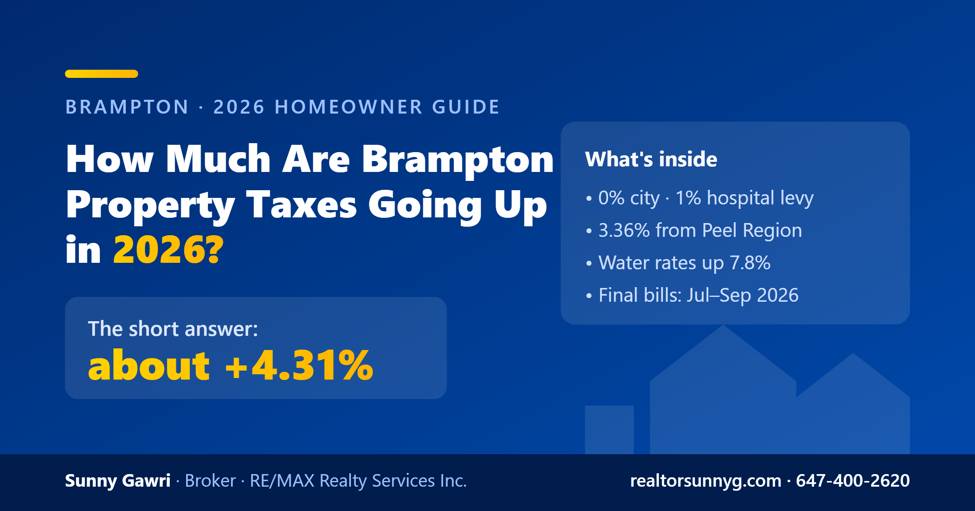
The average Brampton homeowner's total property tax bill is going up about 4.31% in 2026. The City of Brampton's own portion rose 0%, plus a 1% levy for Brampton's second hospital (about $73 on an average home). The larger share comes from Peel Region, which approved a 3.36% increase (about $266 on a typical residential bill). The provincial education portion did not change. Final tax bill instalments are due July 22, August 19, and September 23, 2026.
If you own a home in Brampton, you probably saw the headline that the City passed its 2026 budget with a 0% increase to the municipal portion of your property taxes — and then opened your bill and noticed the number went up anyway. You're not imagining it, and you're not being overcharged.
Here's what's actually happening, exactly what it costs you, and why this matters whether you're planning to sell, buy, or hold an investment property this year.
Your tax bill has three parts — the City is only one of them
The single most misunderstood thing about Brampton property taxes is that the City doesn't keep all of it. When you pay your property tax bill, the City of Brampton collects the money on behalf of three different governments:
- The City of Brampton — funds local services like fire, transit, parks, recreation, and snow clearing
- Peel Region — funds police, paramedics, water and wastewater, public health, and long-term care
- The Province of Ontario — funds the education (school board) portion
So when Mayor Patrick Brown and Council announced a 0% increase on the City's portion, that was true — but it only covers roughly a third of your total bill. The rest is set by Peel Region and the Province.
Here's how the 2026 changes break down.
The City of Brampton portion: 0% + a 1% hospital levy
Council adopted the 2026 budget on February 6, 2026, with no increase to the City's operating portion. On top of that, they kept a 1% levy dedicated to Brampton's second hospital — the City's contribution toward its provincially required $125 million commitment to William Osler Health System.
That 1% levy works out to about $73 more per year on an average Brampton home. Even with it, Brampton's municipal tax rate stays among the lowest in the GTA at $1,516 per capita, compared to a GTA average of $1,819 (BMA Municipal Study, 2025).
The Peel Region portion: 3.36%
This is where most of the increase comes from. Peel Region approved a 3.36% increase for 2026, made up of:
- 1.77% for police
- 1.53% for regional services
- 0.06% for other agencies
For the typical residential property, that adds about $266 per year to your bill.
The education portion: no change
The provincial education rate held flat for 2026, so it isn't adding to your increase this year.
Add it up: about 4.31% on the average home
Put the three portions together — 0% from the City, the 1% hospital levy, roughly 3.31 percentage points from Peel's share of your total bill, and 0% from education — and the average Brampton homeowner is looking at a combined increase of about 4.31%.
The exact dollar figure depends on your home's assessed value. Two homes on the same street can carry different bills based on their MPAC assessment, so the percentage is the reliable way to think about it — the dollar amount scales with your specific property.
Don't forget the water bill — it's a separate 7.8% increase
Property tax isn't your only carrying cost from the Region. Peel also approved a 7.8% utility rate increase for water, wastewater, and stormwater in 2026. For the average home, that's about $75 more per year, or roughly 21 cents a day.
It arrives on a separate utility bill, not your property tax bill, but it's real money out of the same household budget — and it's worth factoring in when you're planning your year.
When your 2026 tax bill is due
Brampton splits the year into an interim bill and a final bill, each paid in three instalments. The interim instalments (February 18, March 18, and April 22) have already passed. The ones coming up are the final 2026 instalments:
- July 22, 2026
- August 19, 2026
- September 23, 2026
Missing a due date is expensive. The City charges 1.25% interest per month on overdue balances — that compounds to roughly 15% a year, which is a costly way to carry a shortfall. If cash flow is tight, a pre-authorized payment plan spreads it out and keeps you penalty-free.
What this means if you're selling
If you're listing this year, your property taxes affect the deal in two practical ways.
First, taxes are adjusted at closing. Your real estate lawyer will prorate the year's taxes between you and the buyer based on the closing date, so whatever you've prepaid — or still owe — gets settled on the statement of adjustments. You don't lose the portion you've already paid; it's credited back to you.
Second, carrying costs shape buyer behaviour. In a market where buyers have more choice and more negotiating room, monthly affordability matters. A buyer comparing two similar homes is doing the math on mortgage, taxes, and utilities combined. Knowing your real numbers — and pricing accordingly — is part of a smart listing strategy. This is the same reason getting an accurate sense of what your Brampton home is actually worth matters more than a generic online estimate.
Taxes are also just one line in your total selling costs. If you want the full picture — legal fees, adjustments, and everything else that comes off your bottom line — start with how closing costs work in Brampton.
What this means if you're buying
If you're buying in Brampton this year, build the 2026 numbers into your budget from the start — not after you've fallen for a home.
A useful rule of thumb: property taxes on a Brampton home in the $700K–$900K range typically run into the several thousand dollars per year, and your exact figure comes from the property's assessed value and the current tax rate, not the purchase price. Ask for the actual current tax amount on any home you're seriously considering — the listing or your agent can pull it.
Then layer in the Peel utility costs and your mortgage, and you'll have a realistic monthly carrying cost. That's the number that tells you what you can actually afford, and it's why buyers who plan around it move with confidence in a market where they finally have some breathing room to make good decisions.
What this means if you own an investment property
For landlords, property taxes and the 7.8% utility increase come straight off your net rental yield. If you're carrying a rental in Brampton, run your 2026 numbers again with the new tax and utility figures — a few hundred dollars a year changes the math on a break-even hold.
And if you're renting a unit out, remember these carrying costs sit alongside your other obligations as a Brampton landlord. Knowing your full cost of ownership is what separates a profitable rental from a slow bleed.
The bottom line
Brampton kept its own taxes flat, but your total bill still rose about 4.31% because Peel Region and the hospital levy make up most of the increase — plus a separate 7.8% bump on water and utilities. For most homeowners that's a few hundred dollars more this year, with the final instalments due July 22, August 19, and September 23.
Whether that number changes your plans depends entirely on your situation — your assessed value, your timeline, and whether you're selling, buying, or holding. That's exactly the kind of thing I walk my clients through before we make any move.
Frequently Asked Questions
Why did my Brampton property tax bill go up if the City increase was 0%?
Because the City's portion is only part of your bill. The City of Brampton collects taxes on behalf of itself, Peel Region, and the Province. For 2026 the City's own portion rose 0%, but a 1% hospital levy and Peel Region's 3.36% increase pushed the average total bill up about 4.31%.
How much more will I actually pay in 2026?
The 1% hospital levy adds about $73 to an average Brampton home, and Peel Region's increase adds about $266 to a typical residential bill. Your exact amount depends on your property's MPAC assessed value, so higher-assessed homes pay proportionally more.
When are Brampton's 2026 property taxes due?
The final 2026 instalments are due July 22, August 19, and September 23. The interim instalments (February 18, March 18, and April 22) have already passed. Overdue balances are charged 1.25% interest per month.
Are Brampton water and utility bills going up too?
Yes. Peel Region approved a 7.8% increase to water, wastewater, and stormwater rates for 2026 — about $75 more per year, or roughly 21 cents a day, for the average home. It appears on a separate utility bill from your property taxes.
Do property taxes affect what I'll net when I sell?
Indirectly. Taxes are prorated between you and the buyer at closing, so you're credited for anything you prepaid. They also factor into a buyer's affordability math, which is one reason accurate pricing matters in the current Brampton market.
If you're thinking through what these 2026 numbers mean for selling, buying, or holding in Brampton, I'm happy to walk you through the real figures for your specific situation. Reach out anytime — start with a free, no-obligation home evaluation or call me directly at 647-400-2620.

