
Should You Buy in Brampton Now or Wait for Lower Rates?
Should you buy a home in Brampton now or wait for interest rates to drop?
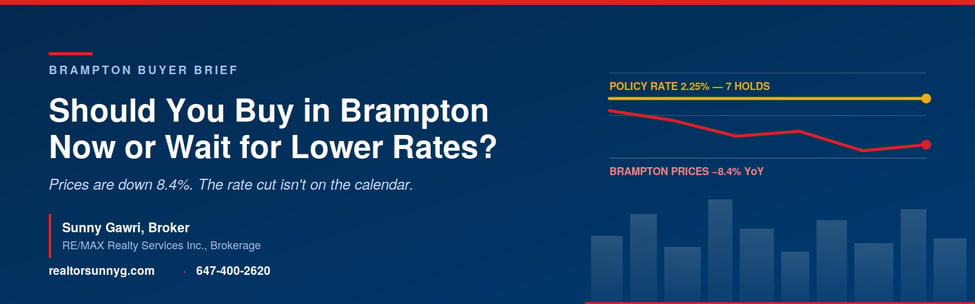
There is no scheduled rate cut to wait for. The Bank of Canada has held its policy rate at 2.25% through seven consecutive decisions, and five-year fixed rates actually moved up in August 2026 because they track bond yields, not the overnight rate. Meanwhile Brampton prices are down roughly 8% year over year and homes are taking about 30 days to sell. You are waiting for a discount you already have, and betting against the one thing that would take it away.
By Sunny Gawri | September 19, 2026
Here's the part nobody tells you: if rates drop the way you're hoping, you will not save money. You will pay more.
That sounds backwards, so let's walk through it with real Brampton numbers.
Where the market actually sits right now. For the 28 days ending September 16, 2026, the average sold price in Brampton was $853,000 — down 8.4% from a year earlier. Detached homes averaged $978,000 (down about 7%), townhouses $723,000 (down about 7%), and condo apartments $431,000 (down about 11%). Homes sold in an average of 30 days at 97% of asking. There were 1,054 new listings against 365 sales — roughly 2.9 new listings for every home that sold.
On the financing side, the Bank of Canada held at 2.25% on September 2, 2026, its seventh straight hold, with the next decision set for October 28. As of mid-September, a five-year fixed sits near 4.39% insured and 4.79% uninsured, with variable around 3.45% insured.
Two numbers in there matter more than the rest: 8.4% down, and 2.9 listings per sale. That combination is the entire buyer opportunity, and it exists because rates are where they are.
The math most buyers get wrong
Run the two scenarios you're actually choosing between.
Thirty-two dollars a month apart. That's the honest answer, and most agents won't give it to you because it doesn't sound dramatic.
But look at what changed underneath that near-identical payment:
- You needed $14,720 more cash at closing for the larger down payment.
- Your land transfer tax went up roughly $1,470.
- You're carrying $58,880 more debt for 25 years.
- And you have no equity cushion, because you bought at the top of the recovery instead of the bottom of the dip.
Now flip it. Buy at today's $978,000 and refinance at 4.00% when rates eventually move — your payment drops to about $4,116. That's $341 a month you keep, on a house you bought $73,600 cheaper.
That's the asymmetry. You can renegotiate a rate. You cannot renegotiate a purchase price after closing. Waiting locks in the one variable you can't fix later and gambles on the one you can.
What a rate cut actually does to your competition
The stress test is the mechanism, and it's worth understanding because it explains every hot market Brampton has ever had.
Under OSFI's rule, you qualify at the greater of your contract rate plus 2% or 5.25%. At 4.79% today, you're being tested at 6.79%. If rates fell to 4.00%, you'd be tested at 6.00% — and your borrowing capacity would jump by roughly 8–10%.
So would everyone else's.
Every buyer currently sitting on the sidelines in Brampton gets that same increase on the same day. They don't trickle back in over 18 months. They come back the week the headline runs. And when borrowing power rises across a whole buyer pool while listings stay flat, you don't get affordability — you get bidding wars.
Rate cuts don't help buyers. They help sellers. Buyers get helped by inventory, and right now Brampton has inventory.
What you can negotiate today that vanishes in a hot market
This is the part that has real dollar value and almost never gets discussed, because it doesn't show up in a headline statistic.
At 2.9 new listings per sale and 30 days on market, you can currently write an offer that includes:
- A financing condition — so you're not personally on the hook if your lender's appraisal comes in under your purchase price
- A home inspection condition — so a $22,000 foundation issue or an aluminum-wired panel is your seller's problem, not your surprise
- A status certificate review if you're buying a condo — so you find out about a special assessment before you own a share of it
- Reasonable closing flexibility, so your possession date matches your lease end or your sale
- A negotiated price, since the 97% sale-to-list ratio means sellers are accepting below asking as a matter of course
In Brampton's 2021 and early 2022 market, buyers waived every one of those to win a property. I watched clients sign firm, unconditional offers on homes they'd seen for eleven minutes. Some of them got hurt.
If you're pricing out "the cost of waiting," those conditions belong in the calculation. A single inspection condition that lets you walk away from a bad roof is worth more than a quarter-point on your rate.
If you're still narrowing down where to buy, my guide to the best neighbourhoods to buy in Brampton in 2026 breaks down price ranges and inventory by pocket, and this look at how buyers and sellers are both finding their footing covers what's changed on both sides of the table.
When waiting is actually the right call
I'm not going to pretend buying now is right for everyone. Wait if:
- Your down payment isn't there yet. Stretching to 5% on an $850,000 purchase means CMHC premiums and a payment that leaves no margin. Another six months of saving genuinely improves your position.
- Your employment situation is unsettled. A mortgage is a 25-year commitment underwritten on this month's income.
- You're carrying high-interest consumer debt. Clearing an 18% credit card balance beats optimizing a 4.79% mortgage every single time.
- You might move in under three years. Transaction costs on both ends rarely get recovered that fast in a flat market.
Those are financial reasons. "Rates might come down" is a forecast, and forecasts are not a plan. Right now money markets are split on whether the Bank's next move is even downward — some pricing points to an increase before a cut.
Frequently Asked Questions
Will interest rates go down in Canada in 2026?
The Bank of Canada has held its policy rate at 2.25% since October 2025, through seven consecutive decisions including September 2, 2026. Fixed mortgage rates rose in August 2026 as Government of Canada bond yields climbed, and some market pricing now points to the next policy move being upward rather than down. Nobody can forecast this reliably — which is exactly why it's a poor basis for a housing decision.
How much do I need to buy an average home in Brampton right now?
On the $853,000 average, a 20% down payment is $170,600 and Ontario land transfer tax runs about $13,535 — less up to $4,000 back if you qualify for the first-time buyer refund. Budget another $2,500–$4,000 for legal fees, title insurance, and adjustments. One advantage of buying in Brampton over Toronto: there's no municipal land transfer tax on top of the provincial one, which saves roughly $13,000 on a purchase at that price.
Are Brampton home prices going to drop further?
Prices in Brampton are down 8.4% year over year but rose about 6% month over month in the most recent period, so the decline has flattened rather than accelerated. Calling the exact bottom is guesswork. What's measurable today is that you have 2.9 new listings per sale and the ability to make conditional offers — leverage that disappears the moment buyer demand returns.
Should I take a fixed or variable rate in Brampton right now?
Variable sits around 3.45% insured versus 4.39% fixed, so variable starts cheaper — but it moves with the Bank of Canada, and the next move isn't clearly a cut. Fixed buys you certainty at a premium of roughly a point. The right answer depends on your risk tolerance, how long you plan to hold, and your penalty exposure if you break early, so run it with a mortgage broker before you commit.
Is now a good time to buy a condo in Brampton?
Brampton condo apartments averaged $431,000, down about 11% year over year — the steepest decline of any property type here, with only 25 sales in the most recent 28-day period. That's the weakest demand and therefore the strongest negotiating position in the market. Just make sure your offer includes a status certificate review so you can check the reserve fund and any pending special assessments before you're committed.
The choice in front of you isn't "buy now or buy cheaper later." It's "buy at a discount with conditions, or buy at a recovery price without them." Those are very different transactions.
Your actual answer depends on your down payment, your timeline, your rate hold, and which pocket of Brampton you're shopping — and that's a 20-minute conversation, not a blog post. If you want to run your specific numbers side by side, reach out and I'll walk you through both scenarios with current listings.
Get Sunny. Get Sold.
Run your numbers with a Brampton broker before the market moves.
About Sunny Gawri
Sunny Gawri is a Broker with RE/MAX Realty Services Inc., Brokerage, leading TEAM Sunny Gawri in Brampton, Mississauga, and the Greater Toronto Area. A RE/MAX Hall of Fame and Lifetime Achievement award recipient, Sunny was named to RankMyAgent's Top 100 Canadian Real Estate Agents (2023, 2024, 2025) and Best of Brampton (2023, 2024, 2025), and ranked #36 among the Top 50 RE/MAX agents in Canada by total transactions for January–June 2026. Sunny helps buyers, sellers, and estate trustees navigate every step of their transaction. Connect with Sunny at realtorsunnyg.com or 647-400-2620.
Market data cited: Zolo Brampton market report (28 days ending September 16, 2026); TRREB Market Watch, August 2026; Bank of Canada rate announcement, September 2, 2026; nesto published mortgage rates, September 18, 2026; OSFI minimum qualifying rate for uninsured mortgages. Figures are accurate as of September 19, 2026 and change frequently — verify current numbers before making a decision. Mortgage payment examples are illustrative, assume a 25-year amortization and semi-annual compounding, and exclude property taxes, insurance, and condo fees. This is not financial or mortgage advice; consult a licensed mortgage professional for your situation.

