
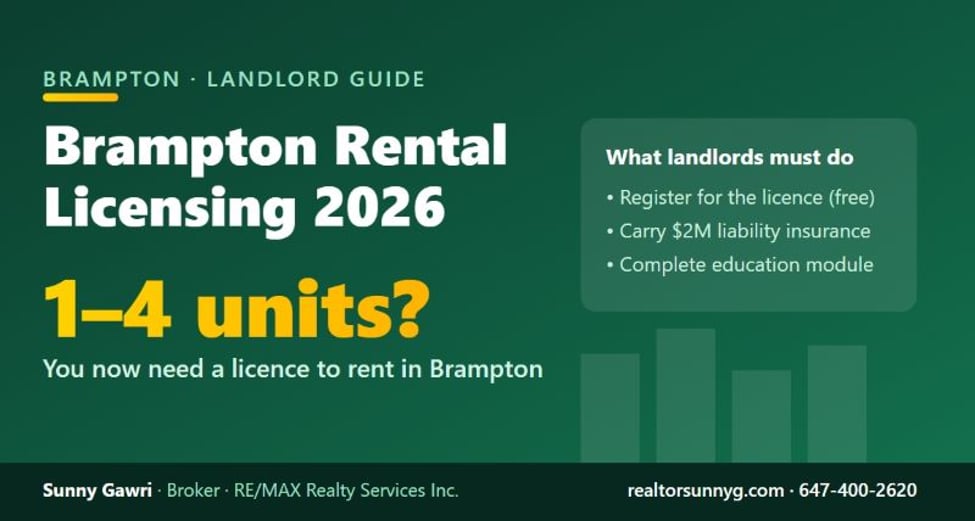
Do you need a licence to rent out your property in Brampton in 2026?
Yes. As of January 1, 2026, the City of Brampton's Residential Rental Licensing (RRL) program applies city-wide across all 10 wards. If you rent out a property with one to four units, you must hold a valid Residential Rental Licence. The licence itself is free, but you'll need to complete a one-time Landlord Education Module and carry at least $2 million in liability insurance. Renting without a licence can bring fines starting at $750 and rising to $1,500 for continued non-compliance.
If you own a rental property in Brampton — or you're thinking about buying one — the rules changed at the start of this year, and a lot of owners still haven't caught up.
For the past two years, Brampton's Residential Rental Licensing program only applied to a handful of wards. That's over. As of January 1, 2026, the program covers the entire city. Every owner renting out a home with one to four units now needs a licence, and the penalties for skipping it are real.
Here's what actually changed, what you have to do, and what it means whether you're holding a rental, buying one, or selling one.
What changed on January 1, 2026
Brampton launched the RRL pilot in wards 1, 3, 4, 5, and 7. On January 1, 2026, the city expanded it to the remaining wards — 2, 6, 8, 9, and 10 — so the program is now city-wide. Council also extended the pilot for another three years, subject to annual review.
The idea behind the program is renter safety: making sure rental units meet fire, electrical, and property-maintenance standards, and that landlords understand their obligations. For owners, the practical effect is simpler to state — if you rent, you register.
If your rental is in one of the newly added wards, this is brand new for you in 2026. If you were already licensed in one of the original wards, you still renew every year.
Who needs a licence — and who's exempt
The licence applies to rental properties with one to four units. That includes:
- Single dwelling units rented out as a whole
- Two-unit dwellings (a home with a legal second unit, such as a basement apartment)
- Multi-unit residential dwellings up to four units — triplexes, fourplexes, and garden or garden-suite arrangements
Several property types are exempt, including:
- Buildings with more than four units
- Hotels and motels
- Lodging houses
- Supportive housing, homes for special care, long-term care homes, residential care homes, and senior care residences
The four-unit line is the one that catches most small investors. A legal basement apartment counts. A duplex counts. If you're renting a single-family home in East Credit, a condo townhome near Hurontario, or a home with a basement unit in Northgate, you're squarely inside the program.
What the licence actually requires
The good news for owners: there's no application fee, and annual renewal is free. The city waived the fees. The requirements are about safety and accountability, not revenue. Here's what you need to have in place:
- A completed Landlord Education Module. This is a one-time online course covering basic fire safety, property maintenance, and tenant and landlord responsibilities. You'll upload the completion certificate with your application.
- Proof of liability insurance — a Certificate of Insurance confirming at least $2 million in coverage.
- A property that meets safety and building standards — working smoke and carbon monoxide alarms, approved and legal occupancy, and proper upkeep including lawn and snow maintenance.
- Permission for the City to inspect the property.
On inspections, Brampton uses what it calls an intelligence-led approach. Rather than inspecting every home, Enforcement & By-Law Services reviews complaints, property records, and potential safety concerns to prioritize units that may be operating unsafely or outside the by-law. That means a clean, compliant, well-documented rental is unlikely to draw attention — but an unlicensed or unsafe one can.
How to apply for your Residential Rental Licence
The process runs through the City's online portal, and for most owners it's straightforward:
- Confirm your unit is compliant. Check that smoke and CO alarms work, that occupancy is legal and approved, and that the property is properly maintained.
- Complete the Landlord Education Module online and save your completion certificate.
- Get your Certificate of Insurance showing a minimum of $2 million in liability coverage.
- Apply through Brampton's online RRL portal, attaching your education certificate, insurance certificate, and any other required documents.
- Grant inspection permission as part of the application.
- Renew every year — the renewal is free, but it isn't automatic, so mark the date.
If a unit isn't legal or up to standard yet — an unpermitted basement apartment is the classic example — that's the piece to resolve before you apply, not after. It's also exactly the kind of issue that affects a property's value and marketability if you ever decide to sell.
What this means if you're buying or selling a Brampton rental
This is where the licensing program stops being paperwork and starts affecting real money.
If you're buying an investment property in Brampton, the licence and the legality of every unit are now part of your due diligence. A home advertised as having "income potential" from a basement apartment is only worth that income if the unit is legal and can be licensed. Before you write an offer, it's worth confirming the unit's status — and building any needed conditions into your Agreement of Purchase and Sale. If you're weighing where to buy, our guide to the best neighbourhoods to buy in Brampton is a useful starting point, and it pairs well with understanding the full closing costs on a Brampton purchase.
If you're selling a tenanted or licensed rental, being able to show a valid licence, a legal second unit, and a clean compliance history is a selling point. It removes uncertainty for the buyer and supports your price. The reverse is also true: an unlicensed rental or an unpermitted unit can turn into a negotiation problem, or a reason a deal falls apart. In a market where buyers already have room to be selective, you don't want a compliance question hanging over your listing.
Every situation is different, and the requirements can change with annual reviews, so it's worth confirming the current details on the City of Brampton's RRL page or with someone who works in this market day to day. This is exactly the kind of thing I walk investor clients through before they buy or list — because the licence status quietly shapes both the price and the timeline.
Frequently Asked Questions
Does the Brampton rental licence cost anything?
No. The City of Brampton waived the application fee, and annual renewals are free. Your real costs are indirect — carrying at least $2 million in liability insurance and bringing the unit up to safety and occupancy standards if it isn't already.
Do I need a licence for a basement apartment in Brampton?
Yes, if you rent it out. A home with a legal second unit is a two-unit dwelling under the program, which means it needs a Residential Rental Licence. The unit also has to be legal and meet occupancy and safety standards — an unpermitted basement apartment needs to be resolved first.
Which Brampton wards need a rental licence in 2026?
All of them. The program originally covered wards 1, 3, 4, 5, and 7, and on January 1, 2026, it expanded city-wide to include wards 2, 6, 8, 9, and 10. Every ward is now included.
What happens if I rent without a licence in Brampton?
Non-compliance can bring fines starting at $750 and escalating to $1,500 for continued violations. Brampton uses complaint- and record-driven enforcement to identify unlicensed or unsafe rentals, so operating without a licence is a real risk.
Does the rental licence affect the value of my property?
It can. A legal, licensed rental with compliant units is easier to sell and supports your asking price, because the buyer knows the income is real and the property meets the by-law. An unlicensed rental or an unpermitted unit can become a negotiating point or a reason a sale stalls.
If you own a Brampton rental, or you're thinking about buying or selling one, the licensing rules are now part of the deal — and getting them right protects both your income and your property's value. I'm happy to walk you through what it means for your specific property, whether you're holding, buying, or listing. Reach out anytime.
About Sunny Gawri
Sunny Gawri is a Broker with RE/MAX Realty Services Inc., Brokerage, leading the Sunny Gawri Team in Brampton, Mississauga, and the Greater Toronto Area. A RE/MAX Hall of Fame and Lifetime Achievement award recipient, Sunny was named to RankMyAgent's Top 100 Canadian Real Estate Agents (2023, 2024, 2025) and Best of Brampton (2023, 2024, 2025), with a 5.0/5 rating from verified client reviews on RankMyAgent. Sunny helps sellers, buyers, and estate trustees navigate every step of their transaction. Connect with Sunny at realtorsunnyg.com or 647-400-2620.
This article is provided for general information only and does not constitute legal advice. The Residential Rental Licensing program is administered by the City of Brampton and its requirements are subject to annual review and change. Always confirm current requirements on the City of Brampton's Residential Rental Licensing page or with the City directly before acting. Sunny Gawri Team — RE/MAX Realty Services Inc., Brokerage.

