
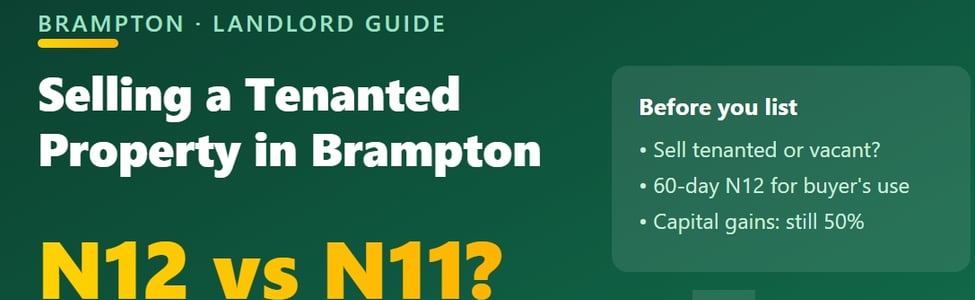
Can you sell a house in Ontario while a tenant is still living in it?
Yes. You can list and sell a tenanted property in Brampton at any time — but the sale doesn't end the tenancy on its own. Under Ontario's Residential Tenancies Act, the lease "runs with the land," so the buyer inherits your tenant on the same rent and terms. If the buyer wants the home empty on closing, vacant possession has to be arranged through an N12 notice (buyer's own use) or an N11 mutual agreement — not by the sale itself.
Selling a rental in Brampton is not the same as selling the home you live in. You have a tenant with legal rights, a lease that survives the sale, and a buyer who may or may not want the property occupied. Get the sequence right and you protect both your sale price and your closing date. Get it wrong and you can lose a deal, face a delay of many months, or expose yourself to serious penalties.
Here's how it actually works — and the decisions you need to make before you list.
First decision: sell it tenanted, or deliver it empty?
This is the choice that shapes everything else, so make it before you put a sign on the lawn.
Selling tenanted (with the lease in place) means the buyer takes over as landlord. This appeals to investors — they get a property that's already producing income from day one, with no vacancy gap. In a Brampton market where buyers have more room to negotiate, a solid tenant paying market rent can be a genuine selling feature to the right buyer.
Selling with vacant possession means the home is empty on closing day. This opens the property up to the much larger pool of owner-occupier buyers — the family that wants to move in themselves. It usually shows better, and often sells to a wider audience, but getting a tenant out legally takes time and has to be done correctly.
There's no universally "right" answer. It depends on your buyer pool, your timeline, your tenant, and the rent you're currently collecting. This is exactly the kind of trade-off I walk landlords through before we decide on a listing strategy.
The rule that trips people up: the sale doesn't end the tenancy
A lot of landlords assume that selling automatically clears the tenant out. It doesn't.
When you sell, the tenancy transfers to the new owner. Your tenant keeps their rent, their lease, and every right they had before. If they're on a fixed-term lease, the buyer has to honour it. Selling is never a legal reason, on its own, to end a tenancy in Ontario.
That means if your buyer needs the home empty, you have to create vacant possession deliberately — and there are only two clean ways to do it.
Route 1: The N12 notice (buyer's own use)
An N12 is the notice used when the buyer — or an immediate family member of the buyer — genuinely intends to move into the property. The key rules:
- The buyer must actually intend to occupy the home. This can't be a workaround to remove a tenant.
- You must give at least 60 days' written notice, and the termination date has to land at the end of a rental period (for month-to-month rent due on the 1st, that's the last day of a month).
- You must pay the tenant one month's rent as compensation, on or before the termination date.
- On a fixed-term lease, an N12 can't take effect until the end of the term.
Two cautions worth taking seriously. First, if a tenant doesn't leave after a valid N12, you can't remove them yourself — you have to apply to the Landlord and Tenant Board (LTB) for an order, and hearing wait times have been running in the range of several months to the better part of a year. That makes it very hard to promise a firm, empty closing date through the N12 route alone.
Second, using an N12 in bad faith — serving it without a real intention to move in — can carry LTB penalties reported up to $35,000, plus damages owed to the tenant and possible reversal of the eviction. Don't improvise here. This is lawyer territory.
Route 2: The N11 agreement (cash-for-keys)
An N11 is a mutual agreement between you and your tenant to end the tenancy voluntarily. Because both sides sign, it's often faster and far more certain than waiting on the LTB.
In practice this frequently takes the form of "cash-for-keys" — you offer the tenant a sum to move out by an agreed date, and you both put it in writing on the N11. It's completely legal in Ontario with genuine mutual consent. For a seller who needs a reliable vacant-possession date, a well-structured N11 is often the cleaner path than gambling on an N12 hearing timeline.
How showings work with a tenant in place
You can show a tenanted home, but the tenant's rights don't pause because you're selling:
- You must give 24 hours' written notice before each showing.
- Showings have to fall between 8 a.m. and 8 p.m.
- The tenant can't unreasonably refuse reasonable access — but they're entitled to that notice every time.
A cooperative tenant makes this smooth. A frustrated one can make showings difficult, which is one more reason to keep the relationship respectful from the first conversation. How you handle your tenant often decides how well the property presents.
Get the Agreement of Purchase and Sale right
Whatever you decide, it has to be written correctly into the Agreement of Purchase and Sale. If the deal calls for vacant possession, that obligation — and who is responsible for delivering it — needs to be spelled out clearly. Without careful drafting, ownership can transfer while the tenant is still in place, leaving the buyer stuck as an involuntary landlord and you exposed to a dispute.
This is why a tenanted sale needs both an agent who understands the strategy and a real estate lawyer who drafts the conditions properly. In Ontario, a lawyer handles your closing regardless — but on a tenanted sale, their wording around possession matters more than usual.
Don't forget the tax side
Your rental isn't covered by the principal residence exemption, so the gain on an investment property is generally taxable. The good news for 2026: the capital gains inclusion rate remains 50% — the proposed increase to two-thirds was cancelled in 2025. Even so, the number can be significant, and depreciation you've claimed over the years can affect it. Talk to an accountant before you sell so there are no surprises at tax time. Your net proceeds also get reduced by the usual selling costs, which you can review in my breakdown of closing costs in Brampton.
A sensible order of operations
If you're a Brampton landlord weighing a sale, here's the sequence I'd suggest:
- Decide your strategy — tenanted sale (investor buyers) or vacant possession (owner-occupier buyers).
- Talk to your tenant early and honestly. Cooperation is worth more than conflict.
- Line up your professionals — an agent who's handled tenanted sales and a real estate lawyer — before you serve any notice.
- Choose the right notice — N11 for a negotiated exit, N12 only where the buyer genuinely intends to occupy.
- Price and market for the right buyer pool, which in a more balanced Brampton market means getting the strategy and the price right from day one.
- Confirm your tax position with an accountant.
Selling with tenants is very doable. It just rewards planning and punishes improvisation. If you're an investor thinking about your exit, it's also worth understanding Brampton's landlord rules while you still own the property — I cover those in my guide to Brampton's rental licensing program. And if you want to avoid the pitfalls that cost sellers money, my post on the top mistakes Brampton sellers make is a good companion read.
Frequently Asked Questions
Do I have to give my tenant notice before selling my house in Ontario?
Not to list or sell — selling doesn't require notice to the tenant. But to show the home you need 24 hours' written notice for each showing, and to deliver the property empty on closing you need either an N12 (buyer's own use, 60 days' notice plus one month's rent compensation) or a signed N11 agreement.
Can the buyer make me evict my tenant?
Only through the proper process, and only if the buyer or their immediate family genuinely intends to move in — which is what triggers a valid N12. You can't be forced to evict simply because a buyer prefers an empty home; that buyer would instead need to negotiate an N11, or buy the property with the tenant in place.
Is cash-for-keys legal in Ontario?
Yes. Paying a tenant to end their tenancy early is legal when both sides agree in writing, usually documented on an N11. For a seller who needs a dependable vacant-possession date, it's often more reliable than waiting months for a Landlord and Tenant Board hearing.
Will I pay capital gains tax when I sell my Brampton rental?
Most likely, yes — a rental property doesn't qualify for the principal residence exemption. For 2026 the capital gains inclusion rate is 50%, but depreciation and your specific situation affect the final number, so confirm it with an accountant before you list.
Should I sell my Brampton rental empty or with the tenant in it?
It depends on your buyer pool and timeline. A tenanted sale targets investors and avoids a vacancy gap; a vacant sale opens the property to owner-occupiers and usually shows better. The right call comes down to your rent, your tenant, and current market conditions — worth mapping out with a local agent before you list.
The bottom line
Selling a tenanted property in Brampton comes down to one early decision — sell it occupied or deliver it empty — and then following Ontario's rules precisely from there. Do that, and a tenant is a manageable detail rather than a deal-breaker.
If you're thinking through a rental sale and want to know which strategy fits your property, tenant, and timeline, I'm happy to walk you through it and give you a clear picture of what your home could sell for. You can start with a free home evaluation or reach out anytime.
Sunny Gawri is a Broker with RE/MAX Realty Services Inc., Brokerage, leading the Sunny Gawri Team in Brampton, Mississauga, and the Greater Toronto Area. A RE/MAX Hall of Fame and Lifetime Achievement award recipient, Sunny was named to RankMyAgent's Top 100 Canadian Real Estate Agents (2023, 2024, 2025) and Best of Brampton (2023, 2024), with a 5.0/5 rating from verified client reviews on RankMyAgent. Sunny helps sellers, buyers, and estate trustees navigate every step of their transaction. Connect with Sunny at realtorsunnyg.com or 647-400-2620.

